

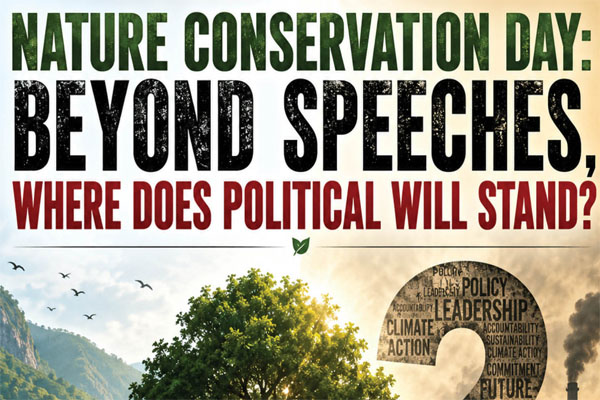
As climate risks intensify and natural resources diminish, the true measure of leadership lies not in promises but in policies that protect the environment and secure the future.
Every year on 28 July, World Nature Conservation Day reminds humanity of its collective responsibility to safeguard the Earth’s natural resources. Yet, while governments across the globe issue statements reaffirming their commitment to environmental protection, the gap between political declarations and on-the-ground implementation remains striking. The question is no longer whether nature should be conserved, but whether political systems possess the vision and determination to make conservation a national priority.
The twenty-first century has witnessed unprecedented environmental challenges. Climate change has intensified floods, droughts, heatwaves, and forest fires. Biodiversity is declining at an alarming pace, while rivers, forests, wetlands, and agricultural lands continue to face increasing pressure from expanding urbanisation and unsustainable development. These are not merely environmental concerns—they are governance issues that influence food security, public health, economic stability, and national security.
Political leadership shapes the destiny of natural resources. Laws governing forests, water bodies, mining, land use, pollution control, and renewable energy originate in legislative chambers and are implemented through executive institutions. Environmental protection therefore depends not only on scientific knowledge but also on political will, administrative efficiency, and institutional accountability.
Unfortunately, environmental concerns often receive attention only after disasters occur. Floods expose weaknesses in urban planning, landslides reveal the consequences of reckless construction, and polluted rivers highlight failures in regulation. Disaster relief frequently becomes more visible than disaster prevention. This reactive approach is costly in both human and economic terms. Investing in conservation before a crisis is far more effective than rebuilding after one.
Development and conservation are frequently portrayed as competing priorities. In reality, sustainable development seeks to balance economic growth with environmental protection. Roads, housing, tourism, and industrial expansion are essential for progress, but they must be planned with ecological limits in mind. Environmental impact assessments, transparent public consultations, scientific planning, and strict enforcement of regulations are indispensable if development is to remain sustainable.
The Himalayan region, including Jammu and Kashmir, illustrates this challenge vividly. Its glaciers, forests, rivers, and wetlands are ecological assets of immense importance. Yet changing weather patterns, rapid urban growth, shrinking green spaces, waste management issues, and pressure on fragile ecosystems demand stronger environmental governance. Protecting these natural resources is not only an ecological imperative but also an economic necessity for tourism, agriculture, horticulture, and water security.
Political leadership must also recognise that climate change is no longer a distant threat. Communities across India increasingly experience extreme weather events that disrupt livelihoods and strain public infrastructure. Conservation policies should therefore be integrated into urban planning, agriculture, disaster management, education, and public finance rather than being treated as isolated environmental programmes.
Citizens, too, have an indispensable role. Democracies function best when informed citizens demand accountability. Public participation in environmental decision-making, responsible consumption, community-led conservation initiatives, and support for sustainable practices strengthen governance. Environmental protection succeeds when governments, civil society, scientists, businesses, and local communities work together.
Equally important is transparency. Environmental clearances, pollution monitoring, land-use changes, and conservation projects should be subject to public scrutiny. Open access to reliable environmental data enables citizens, researchers, and policymakers to make informed decisions and build trust in public institutions.
World Nature Conservation Day should therefore be more than a ceremonial observance. It should serve as an annual report card on environmental governance. Governments must evaluate whether forest cover has improved, wetlands have been restored, pollution has declined, renewable energy has expanded, and climate resilience has strengthened. Progress should be measured through outcomes, not announcements.
The politics of the future will increasingly be shaped by the environment. Nations that invest wisely in conservation today will enjoy greater resilience, healthier populations, stronger economies, and enhanced global credibility tomorrow. Those that ignore ecological realities risk paying a far higher price in recurring disasters, declining natural resources, and weakened public confidence.
Nature does not recognise political boundaries or electoral cycles. Rivers flow across districts, forests sustain entire regions, and the atmosphere belongs to everyone. Conservation, therefore, should never become a partisan issue. It is a constitutional, moral, and intergenerational responsibility. On this Nature Conservation Day, the challenge before every government and every citizen is clear: replace rhetoric with resolve, and transform environmental commitment into measurable action. The future of our democracy is inseparable from the future of our environment.
KP BUREAU

