

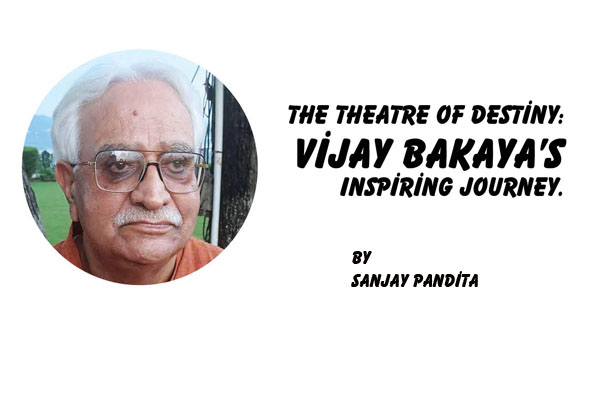
SANJAY PANDITA
There is perhaps no greater illusion that accompanies youth than the belief that life will faithfully follow the script we have so carefully written for ourselves. We imagine our future with remarkable certainty. We assign ourselves professions, define ambitions, chart milestones, and convince ourselves that determination alone will carry us towards the destination we have chosen. Yet life, with its mysterious wisdom, often has other plans. It quietly rearranges the scenes, introduces unexpected characters, alters the direction of the narrative, and, before we realise it, places us upon an altogether different stage.
At first, these deviations appear disappointing, even unjust. We wonder why our cherished dreams have remained unfulfilled. But with the passage of time, we discover that destiny seldom destroys sincere aspirations; it transforms them. It takes the discipline acquired in one pursuit, the lessons learnt in one arena, the values cultivated through one passion, and prepares us for a calling that may ultimately be greater than the one we had imagined.
History offers many examples of individuals whose lives changed direction in extraordinary ways. Some who dreamt of becoming artists became scientists; some who aspired to scholarship became statesmen; some who sought fame found fulfilment in service. Their greatness lay not in resisting destiny’s intervention but in embracing it with the same dedication they had once reserved for their original dreams.
Among such remarkable lives, the journey of Vijay Bakaya stands out as a profoundly inspiring example. It is a story that speaks not merely of professional success but of the quiet relationship between passion, preparation, and providence. It reminds us that excellence is never wasted, that sincere effort always finds expression, and that the road destiny chooses for us is often wider and more meaningful than the one we initially intended to travel.
Today, Vijay Bakaya is remembered as one of India’s most distinguished civil servants, a man who occupied some of the highest positions in public administration with grace, wisdom, and impeccable integrity. His administrative career earned admiration across the country, establishing him as a model of efficient governance and enlightened public service.
Yet behind the accomplished administrator stood another Vijay Bakaya—one whom only theatre lovers of an earlier generation remember with affectionate admiration.
Long before he entered the corridors of governance, he commanded another stage altogether.
He was among the finest actors that Rajasthan had produced.
The theatre was not a pastime that filled leisure hours. Nor was it an extracurricular activity undertaken to embellish a résumé. It was his first love, a world in which imagination met discipline, where literature breathed through performance, and where human emotions found their richest expression. Those who watched him perform believed they were witnessing the emergence of an actor destined for national recognition.
Ironically, this extraordinary journey into theatre began without design.
As an undergraduate student pursuing English Honours at the University of Rajasthan in Jaipur, Vijay Bakaya had little idea that the stage would transform his life. He was known primarily for his academic brilliance. Literature fascinated him, language came naturally to him, and his intellectual curiosity distinguished him among his peers.
One of his professors, Dr. Bhalla, was deeply devoted to theatre and regularly directed English plays for the University’s celebrated Open Air Theatre. Looking beyond conventional criteria for casting, he selected students who possessed literary sensitivity rather than theatrical experience. Bakaya was one such student.
He had never acted before.
Yet Dr. Bhalla saw in him something that perhaps even Bakaya himself had not yet recognised.
It proved to be an inspired decision.
The stage awakened possibilities that had lain dormant within the young student. As rehearsals progressed, he discovered that acting demanded much more than memorising dialogue. It required entering another person’s emotional universe, understanding motives, inhabiting silences, and expressing truths that ordinary conversation could never fully reveal.
The theatre became another university.
Here he studied not merely dramatic technique but the complexity of human character itself.
His education in English literature naturally led him towards Shakespeare, whose timeless plays offered the finest laboratory for an aspiring actor. Over the next few years, Bakaya appeared in productions of A Midsummer Night’s Dream, Hamlet, and Macbeth. Each role demanded intellectual rigour and emotional maturity.
In Hamlet, he encountered philosophical introspection. In Macbeth, he confronted the corrosive nature of ambition. In A Midsummer Night’s Dream, he explored the enchanting ambiguities of love, illusion, and human folly.
Every performance became an education beyond textbooks.
Shakespeare was no longer merely a literary genius to be studied in classrooms. Through performance, his characters became living companions, teaching the young actor subtle lessons about courage, doubt, temptation, compassion, pride, and redemption.
The culmination of his English theatre came with Samuel Beckett’s Waiting for Godot.
Bakaya played Lucky, perhaps one of the most demanding roles in twentieth-century drama. Lucky’s famous monologue is not simply a speech; it is a torrent of fractured consciousness requiring exceptional precision, rhythm, concentration, and emotional control.
His portrayal astonished audiences.
It established beyond doubt that Vijay Bakaya possessed remarkable dramatic abilities and could master even the most intellectually challenging theatrical forms.
Yet destiny had only begun its rehearsal.
After completing his graduation, he enrolled for a Master’s degree in History. By now his reputation as a gifted actor had spread beyond the English department. Friends involved in Hindi theatre persuaded him to join their productions.
The transition proved transformative.
English classical drama had refined his intellect; Hindi theatre broadened his emotional reach.
The troupe was led by the distinguished Bollywood actor Pinchoo Kapoor, who had chosen Jaipur as his home and was passionately committed to nurturing theatre in the city. Kapoor immediately recognised Bakaya’s exceptional talent.
He entrusted him with leading roles.
These productions, ranging from social dramas to delightful comedies, attracted enthusiastic audiences throughout Jaipur. Night after night, Bakaya displayed a remarkable ease before spectators. His commanding voice, expressive eyes, restrained body language, and effortless dialogue delivery made him one of the troupe’s principal attractions.
He possessed that rare quality found only in accomplished actors—the ability to disappear into a character so completely that audiences ceased to see the performer.
Performance after performance, his reputation grew.
His final production under Pinchoo Kapoor’s direction was Kanchanranga, Mohan Rakesh’s Hindi adaptation of a celebrated Bengali play. It marked not merely the conclusion of an artistic chapter but the threshold of another.
Soon another towering personality entered his life.
Mohan Maharishi, one of India’s most respected theatre directors, returned to Jaipur after an assignment in Mauritius and founded Natrang. His vision was revolutionary. He wished to introduce audiences to modern Hindi theatre that explored psychological complexity, social realism, and contemporary human dilemmas.
Bakaya joined Maharishi’s company with the same enthusiasm that had characterised every stage of his artistic evolution.
He appeared in productions such as Shuturmurg, Hatya Ek Aakar Ki, and Mohan Rakesh’s celebrated Adhe Adhure.
These were not conventional plays.
They required actors to communicate conflict through silence, uncertainty through pauses, and emotional turbulence through the slightest gesture. The exaggerated style of earlier theatre gave way to subtle realism.
Bakaya adapted effortlessly.
His performances displayed increasing maturity, proving that genuine talent is distinguished not merely by brilliance but by the willingness to evolve.
Then came the defining production of his theatrical career.
It was Aazar Ka Khwaban, an Urdu adaptation of George Bernard Shaw’s immortal Pygmalion.
Bakaya portrayed Aazar, the counterpart of Professor Henry Higgins, while the gifted Ila Arun appeared as Hajjo, corresponding to Eliza Doolittle.
The production was nothing short of phenomenal.
Every performance drew overflowing audiences. Theatre lovers marvelled at the extraordinary chemistry between the two principal actors. Critics praised Bakaya’s remarkable restraint, emotional intelligence, and commanding stage presence.
He had reached the pinnacle of his theatrical journey.
The production eventually travelled to the National School of Drama in New Delhi, where it attracted the attention of India’s most revered theatre personality.
Among those present was the legendary Ebrahim Alkazi.
Few names command greater reverence in Indian theatre than Alkazi. Widely regarded as the architect of modern Indian stagecraft, he shaped generations of actors and transformed the National School of Drama into one of the world’s finest institutions for dramatic arts.
After witnessing Bakaya’s performance, Alkazi was deeply impressed.
Recognising the rare promise before him, he reportedly urged the young actor to abandon his plans of joining the Indian Administrative Service and devote himself entirely to theatre.
It was perhaps the highest tribute any aspiring actor could hope to receive.
To earn admiration from ordinary audiences is gratifying.
To receive recognition from one’s greatest master is unforgettable.
Around the same period, admirers had begun affectionately calling Vijay Bakaya the “Dilip Kumar of Rajasthan.”
The comparison was neither casual nor exaggerated.
Like Dilip Kumar, Bakaya believed in understatement rather than theatrical excess. His performances were marked by emotional depth, quiet dignity, and psychological authenticity. He demonstrated that true acting lies not in loud expression but in truthful expression.
Everything appeared settled.
His future seemed inseparable from theatre.
The stage loved him.
Audiences admired him.
Masters blessed him.
Recognition awaited him.

Had anyone predicted that this gifted actor would soon abandon theatre altogether, few would have believed it.
Yet destiny had silently prepared another script.
At the very moment when theatrical success beckoned most irresistibly, Vijay Bakaya made a decision that surprised many.
He entered the Indian Administrative Service.
To some observers, it seemed as though Indian theatre had suffered an irreplaceable loss.
Perhaps it had.
But India gained something equally precious.
It gained an administrator shaped by the humanities.
It gained a civil servant whose understanding of human nature had not been acquired solely from law books, regulations, or administrative manuals but from years spent inhabiting the joys, fears, hopes, failures, and contradictions of countless characters upon the stage.
Long before he learnt to govern institutions, theatre had taught him to understand people.
The actor had unknowingly prepared the administrator.
Every rehearsal had taught him patience. Every role had cultivated empathy. Every performance had strengthened communication. Every audience had reminded him of accountability. Every production had demanded teamwork. Every director had instilled discipline. Every failure had nurtured resilience.
These were not merely theatrical virtues.
They were the very foundations of enlightened public administration.
It is therefore hardly surprising that Vijay Bakaya’s distinguished civil service career reflected the same qualities that had made him a remarkable actor—clarity without arrogance, authority without intimidation, compassion without sentimentality, and firmness without harshness.
His life demonstrates that no sincere passion is ever wasted.
Even when it does not become our profession, it becomes our preparation.
This is perhaps the most enduring lesson his story offers to young people standing uncertainly at the crossroads of ambition.
Modern society often teaches us to identify success with a single destination. We become so attached to one dream that any deviation appears to be failure. We measure our lives against carefully constructed plans and feel defeated when circumstances alter them.
But life possesses a wisdom greater than our calculations.
The destination may change.
The calling may change.
Even the dream itself may change.
What must never change is the excellence with which we pursue whatever destiny ultimately entrusts to us.
Had Vijay Bakaya remained in theatre, Indian drama might indeed have gained one of its finest actors.
Instead, India gained one of its finest administrators.
There is no tragedy in this transition.
There is only fulfilment expressed through another medium.
The applause of the auditorium gave way to the quiet satisfaction of public service.
The stage expanded.
The audience became an entire nation.
Life is seldom a straight road from ambition to achievement. More often, it is a series of unexpected turns that reveal possibilities we had never imagined. Dreams do not always disappear; sometimes they simply change their address. What begins beneath the glow of stage lights may ultimately find its highest expression in the service of society. What appears to be a detour may, in truth, be destiny’s chosen route.
Vijay Bakaya’s remarkable journey reminds us that greatness is not confined to a profession. It is a habit of mind, a discipline of character, and a lifelong commitment to excellence. Destiny may choose another stage, rewrite the dialogue, alter the setting, and assign us an altogether different role. Yet those who bring sincerity, integrity, and unwavering dedication to every responsibility entrusted to them never truly abandon their dreams—they elevate them.
That is the enduring significance of Vijay Bakaya’s life. He did not merely move from theatre to administration. He carried the soul of an artist into the service of the nation. In doing so, he affirmed one timeless truth: when talent is guided by character and passion is tempered by purpose, every stage becomes a place of distinction, and every role, however unexpected, becomes a masterpiece in the grand theatre of life.
Sanjay Pandita is a poet, columnist & critical analyst , can be reached at sanjaypanditasp@gmail.com

