

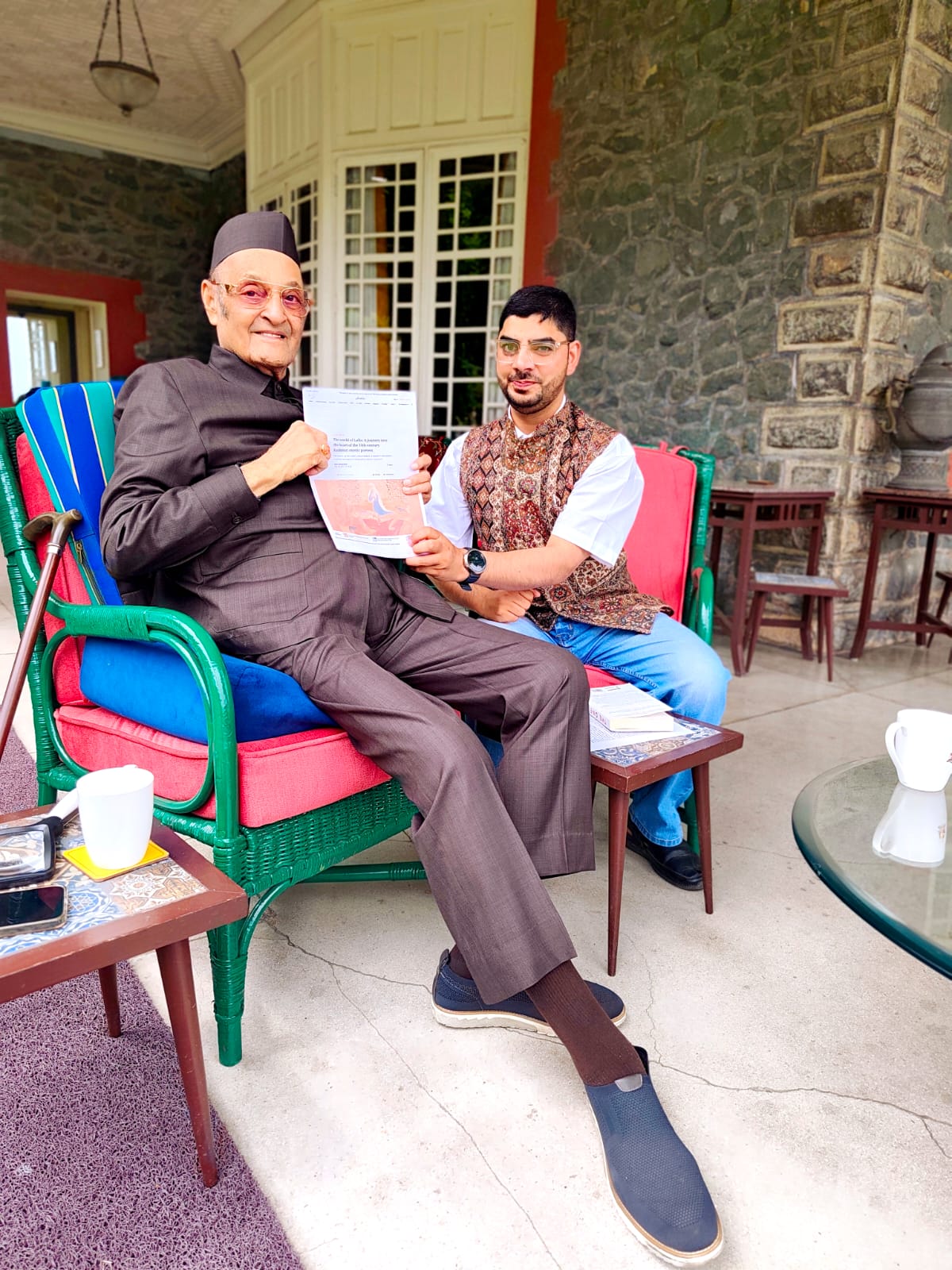
Srinagar 19 Jun : Renowned scholar, author, and public intellectual Amir Suhail Wani today had the privilege of meeting Dr. Karan Singh, one of India’s most respected elder statesmen, distinguished scholars, philosophers, and former parliamentarians.
The meeting provided an opportunity for a thoughtful exchange on Kashmir’s rich cultural, intellectual, and spiritual heritage, particularly the enduring relevance of its Rishi-Sufi traditionand the role of interfaith dialogue in strengthening social harmony. The discussion centered on the values of compassion, wisdom, mutual respect, and coexistence that have historically shaped the civilizational ethos of Kashmir.

Amir Suhail Wani, whose work has focused extensively on spirituality, literature, interfaith understanding, and the intellectual traditions of Kashmir, shared with Dr. Karan Singh a selection of his research articles and writings on Lal Ded (Lalleshwari), spirituality, Kashmiri literature, and the region’s composite cultural heritage. Dr. Karan Singh appreciated the depth of Amir’s scholarship and intellectual engagement with these themes and extended his best wishes for his future academic and literary pursuits.
The two also reflected on the importance of preserving Kashmir’s rich traditions of learning, ethical reflection, and cultural dialogue. They discussed the role of education, literature, scholarship, and public engagement in fostering understanding among communities and nurturing a constructive environment for future generations.
During the interaction, Dr. Karan Singh also took note of Amir Suhail Wani’s long-standing struggle in the JKSSB Junior Engineer (Electrical) recruitment matter, in which Amir, despite being a meritorious candidate and a person with disability, has pursued legal remedies through constitutional and judicial channels while maintaining faith in due process and the rule of law. Dr. Singh appreciated Amir’s perseverance, resilience, and commitment to justice, observing that his journey reflected a steadfast belief in democratic institutions and the judicial process.
Expressing solidarity with Amir’s pursuit of justice, Dr. Karan Singh acknowledged the challenges he has faced over the years and appreciated the dignity and patience with which he has pursued his case. He conveyed his hope that the matter would reach a fair and just resolution in accordance with law.
The conversation further highlighted the importance of individual and collective efforts in preserving cultural heritage, encouraging meaningful dialogue, and creating spaces where ideas can be exchanged with openness, civility, and respect. Both noted that Kashmir’s diverse intellectual and spiritual traditions continue to offer valuable resources for promoting empathy, responsible citizenship, and a deeper appreciation of shared human values.
The meeting concluded with a shared appreciation for Kashmir’s remarkable cultural inheritance and an expression of hope that its traditions of wisdom, learning, spirituality, and human fellowship will continue to inspire positive engagement across society and contribute to a more harmonious future.

