

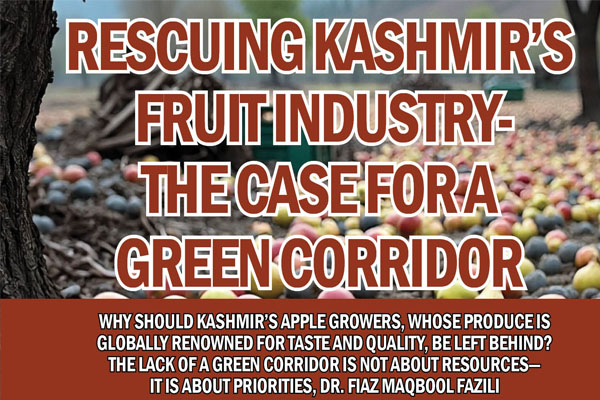
Why should Kashmir’s apple growers, whose produce is globally renowned for taste and quality, be left behind? The lack of a green corridor is not about resources—it is about priorities, Dr. Fiaz Maqbool Fazili
Dr. Fiaz Maqbool Fazili
Kashmir has long been celebrated as the “fruit bowl of the subcontinent.” Its apple orchards, sprawling across thousands of hectares, not only paint the valley in hues of green and red but also form the backbone of its rural economy. The apple alone contributes nearly 8% to Jammu & Kashmir’s Gross Domestic Product (GDP) and provides direct or indirect employment to more than 30 lakh people, from orchard workers and packers to transporters and traders. Yet, despite this immense contribution, the industry today faces a crisis that is both avoidable and shameful—its lifeline, the smooth movement of fruit, is being throttled.
At the heart of the problem lies the absence of a green corridor for fruit transport. Each harvest season, thousands of trucks carrying apples are stranded for days on the Srinagar–Jammu National Highway, Kashmir’s only road artery to outside markets. The reasons are depressingly familiar: landslides, road widening works, arbitrary traffic halts, and security restrictions. For a perishable commodity like apples, delay is nothing short of disaster. Fruit worth crores rots in crates, quality deteriorates, and by the time it reaches mandis in Delhi or Mumbai, it is either unsellable or sold at throwaway prices. The farmer who nurtured his orchard for a year is left helpless, trapped between debt and despair.
Fruit growers Lament-The situation is not new. For decades, Kashmiri growers have pleaded for uninterrupted transport during harvest months. Their pleas often get lost amid bureaucratic assurances. Meanwhile, other regions of India have implemented structured logistics support for perishable goods. Himachal Pradesh and Uttarakhand, for instance, benefit from priority clearances for apple trucks and access to cold chains. Maharashtra’s grape and mango growers rely on air-cargo subsidies and dedicated freight corridors to reach Europe and the Gulf. In contrast, Kashmir—despite being geographically disadvantaged—lacks even the basic guarantee of free road passage.
This neglect is tragic, because horticulture is one of the few success stories in Kashmir’s otherwise fragile economy. With limited industrial base and dwindling tourism due to unrest and global shocks, fruit cultivation has been the safety net of thousands of families. But without logistics support, that safety net is tearing.
A green corridor is not a luxury—it is a necessity. The concept is simple yet transformative: designate an uninterrupted, priority transport route for perishable goods like fruit during the critical harvest months of September to December. In practice, this would mean:
Uninterrupted Highway Passage: Trucks carrying fruit should be exempt from routine traffic halts, especially during security convoys or road repairs. GPS tagging and special permits can ensure security concerns are addressed without stalling transport.
Enhance Cold Storage facilities and Logistics Hubs: Setting up temperature-controlled storage and packaging centers at all districts, sub district levels especially fruit producing areas strategic points/towns( Shopian, Sopore ,Bandipore ,Qazi Gund, Rambam, Udhampur, Ganderbal and Jammu etc) would prevent spoilage and allow staggered market release.
Rail and Air Integration: The upcoming rail link to Kashmir must prioritize freight wagons for fruit. Similarly, air-cargo subsidies for apple exports can diversify markets beyond Delhi, ensuring competitive prices.
Digital Coordination: A central control room, with representatives from horticulture, transport, and highway authorities, can monitor real-time truck movement and address bottlenecks instantly.
Market Linkages: Alongside transport, farmers need assured access to mandis and direct linkages with wholesalers and exporters. The green corridor should thus connect to national markets, not merely stop at Jammu.
If implemented with seriousness, these measures could save fruit worth hundreds of crores annually and inject fresh confidence into growers.Recently the administration acted empathetically arranged “ transport of stranded fruit by railway, such action plans must be continuous not only as distress calls .
Lessons from Elsewhere-Globally, countries facing similar geographical and logistical challenges have adopted innovative solutions. In Chile, one of the world’s largest fruit exporters, refrigerated trucks and ships form an unbroken cold chain from orchards to overseas markets. In Turkey, apricot and cherry growers are supported by government-funded cargo corridors to European markets. Closer home, Maharashtra’s mango growers benefit from subsidized flights to Dubai, ensuring freshness and premium prices.
Why should Kashmir’s apple growers, whose produce is globally renowned for taste and quality, be left behind? The lack of a green corridor is not about resources—it is about priorities.
The Human Cost-Behind every stranded truck lies a human story. Consider a small grower in Shopian, who borrows money each spring to buy fertilizers, pesticides, and wooden boxes. By autumn, he fills 500 crates of apples, expecting to sell them at ₹1,000 each in Delhi markets. But after a week of delays on the highway, half his produce rots, prices fall, and he ends up earning only half his investment. The debts remain, the family budget collapses, and the cycle of despair deepens. Multiply this by thousands, and you see why rural Kashmir today is simmering with silent frustration.
The irony is that while leaders talk about doubling farmers’ income, here in Kashmir the farmer is not even assured of recovering his costs. Without systemic intervention, many may abandon orchards altogether—a loss not just to them but to the valley’s economy and culture.
An Appeal for Political Will-Creating a green corridor does not require futuristic technology. It requires political will, administrative coordination, and empathy for the growers who keep Kashmir’s economy alive. The government must stop treating fruit transport as an afterthought. Just as essential supplies like oxygen cylinders during COVID-19 were moved through priority corridors, apples and other perishable commodities deserve similar recognition during harvest season.
Civil society, Groups like GCC (group of concerned citizens, EPG- , environmental protection group etc )too, must play its role. Growers’ associations, chambers of commerce, and NGOs must keep the pressure alive, documenting losses and lobbying with both Srinagar and New Delhi. Media must amplify these voices, turning the plight of fruit transport from a seasonal grievance into a national concern.
The Road Ahead-The creation of a green corridor can do more than rescue the fruit industry—it can revitalize Kashmir’s rural economy. By ensuring timely and efficient transport, growers can access new markets, experiment with value-added products like juices and jams, and even revive exports to the Middle East. In the long term, this can foster agro-industrial growth in the valley, reducing unemployment and stemming the outmigration of youth.
But every journey begins with a single step. The first step is recognition: acknowledging that the current system is broken, that perishable goods cannot wait on roads, and that growers cannot be left at the mercy of chance. The second step is commitment: declaring the Srinagar–Jammu highway a seasonal green corridor for fruit transport and backing it with enforceable regulations. The third step is follow-through: building storage, logistics, and market linkages so that this corridor is not just a road but a lifeline.
Major Pickups! Kashmir’s fruit industry is not just about apples—it is about livelihoods, heritage, and hope. For too long, our growers have borne the cost of systemic neglect, their produce rotting while policymakers looked away. The demand for a green corridor is not charity—it is justice.If we can create highways for goods, railways for coal, and air corridors for industrial supply, why can we not create a corridor of dignity for the Kashmiri grower? The answer lies not in resources but in resolve.
A green corridor for Kashmir’s fruit industry is not a dream; it is an urgent necessity. To delay it further is to betray the hands that feed us. Let this harvest season not be another story of loss. Let it be the season when policymakers finally open the road to prosperity, and let Kashmir’s fruit move freely, carrying with it the taste of resilience, labor, and hope.
The Author is a Surgeon at Mubarak hospital, Healthcare policy analyst, Certified Professional in Quality improvement in Hospitals can be reached at drfiazfazili@gmail.com

