

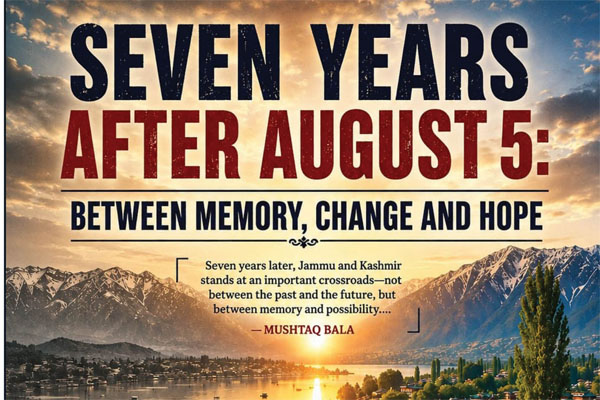
Seven years later, Jammu and Kashmir stands at an important crossroads—not between the past and the future, but between memory and possibility….MUSHTAQ BALA
Mushtaq Bala
Some dates simply become part of history. Others become part of memory. August 5 belongs to the latter.
Seven years have passed since the constitutional changes of August 5, 2019, yet the date continues to evoke emotions that transcend politics. It remains a reminder of a defining moment that reshaped Jammu and Kashmir’s constitutional, political and administrative landscape. Depending on whom one asks, it represents either the beginning of a new chapter of integration and development or the loss of constitutional guarantees and political autonomy. Between these two narratives lies the lived reality of millions of people whose everyday concerns extend far beyond constitutional debates.
History often judges decisions with the benefit of hindsight. People, however, judge them through the realities of their daily lives.
Over the past seven years, Jammu and Kashmir has witnessed remarkable physical transformation. Roads have improved, tunnels have reduced travel time, railway connectivity has moved closer to completion, healthcare infrastructure has expanded, educational institutions have grown, and tourism has staged an impressive revival. Record tourist arrivals, renewed investor interest and ambitious infrastructure projects have undoubtedly altered the economic landscape.
These achievements deserve recognition.
Yet development is not measured only by highways, bridges or investment figures. Its true success is reflected in the confidence of a young graduate searching for meaningful employment, an entrepreneur looking for easier access to finance, a farmer hoping for better returns, an artisan seeking new markets and a family aspiring to a more secure future.
Economic indicators tell one story; lived experiences often tell another.
The restoration of an elected government has revived democratic processes, but the demand for the restoration of full statehood continues to resonate across the political spectrum. It has become one of the few issues that finds support beyond party lines. Democratic institutions draw their greatest strength from public trust, and that trust grows when people feel their voices matter in shaping their future.
Equally important is the question of identity.
Kashmir’s identity has never been defined solely by constitutional provisions. It lives in its language, literature, culture, Sufi traditions, craftsmanship, hospitality and centuries-old spirit of coexistence. These are not merely symbols of the past but assets that can shape the future. Preserving this rich cultural heritage while embracing modern opportunities is not a contradiction—it is a necessity.
Peace, too, remains an unfinished journey.
Periods of stability have enabled tourism, education, business and investment to flourish. Yet every incident of violence serves as a reminder that lasting peace requires more than security arrangements. It demands dialogue, justice, economic opportunity and above all, hope. Sustainable peace grows strongest when citizens believe they have an equal stake in the future.
Perhaps the greatest challenge before Jammu and Kashmir today is not deciding how to remember August 5, but determining how to build the years that follow it.
The aspirations of the people are remarkably consistent. They seek quality education, dignified employment, accountable governance, efficient public services, investment that creates local jobs, a vibrant cultural life and an environment where young people can dream without uncertainty. These aspirations neither belong to one political ideology nor another; they belong to every citizen.
As this anniversary is observed once again, political parties will continue to articulate their respective positions, governments will present their achievements, and public debate will remain as vigorous as ever. That is the nature of democracy.
What must never be lost amid competing narratives is the voice of the ordinary citizen.
For them, progress is not measured by slogans but by opportunities. It is not reflected merely in official announcements but in the quality of everyday life. They seek peace that lasts, governance that listens, development that includes everyone and a future that inspires confidence.
Seven years later, Jammu and Kashmir stands at an important crossroads—not between the past and the future, but between memory and possibility.
The past cannot be rewritten.
The future, however, remains unwritten.
It is in that unwritten future that the greatest responsibility rests—not only on governments and political parties, but on institutions, civil society, the media and every citizen committed to the ideals of peace, democracy and inclusive development.
History will continue to debate August 5.
The people of Jammu and Kashmir, meanwhile, will continue to write the next chapter.
One day at a time.
Mushtaq Bala is Editor-in-Chief of Kashmir Pen, an award-winning filmmaker, cultural commentator, and advocate for peace through narrative media.

