

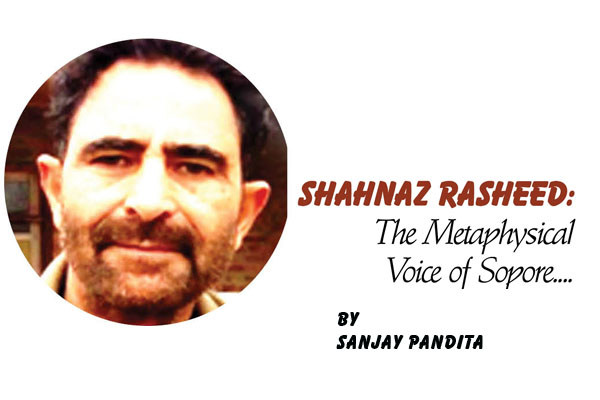
SANJAY PANDITA
In the apple-laden alleys of Nowpora, Sopore—where the scent of spring blossoms mingles with the earthy rhythm of Jhelum’s flow—a luminous literary journey quietly took root. It was here, among orchards and mountains, that Shahnaz Rasheed was born, his voice destined to resonate far beyond the confines of this quaint Kashmiri town. Over the decades, he has blossomed into one of the most compelling figures in contemporary Kashmiri and Urdu literature: a poet, a translator of high repute, an insightful critic, columnist, essayist, and a deeply reflective civil servant. His multifaceted journey weaves together the administrative with the artistic, forming a tapestry that reflects both public duty and poetic devotion.

Educated at the University of Kashmir, with a post-graduate degree in Political Science, Shahnaz Rasheed’s sensibility was sharpened not only by academic rigor but also by the philosophical undercurrents of the land he calls home. As Deputy Secretary in the erstwhile State Legislative Council, he served with discretion and depth. But it is within the quieter, interior spaces of poetry and prose that he has carved out a legacy of enduring resonance. For Rasheed, literature was never an escape from reality—it was a deeper descent into it, a more luminous way of witnessing pain, beauty, and contradiction.
From his earliest verses, one notices a poet deeply rooted in the Kashmiri soil—its anguish, mysticism, silence, and unspoken scars. His debut collection, Dood Khathith Guldanan Manz (“Pain Behind the Flower Vases”), published in 2006, arrived like an elegy dressed in metaphor. The title itself evokes a fragile irony—beauty arranged in vases, yet concealing a quiet suffering. In these poems, Shahnaz doesn’t merely describe the pain of his people; he inhabits it. Each image, be it a fallen petal or a shattered windowpane, seems to echo with suppressed laments. This collection marked a significant departure from traditional Kashmiri verse—it whispered where others shouted, meditated where others mourned.
His second collection, Door Pahan Dewaran Manz (“Within the Walls at a Small Distance”), published in 2017, is a more distilled, introspective companion to the first. If the earlier work gestured outward, capturing the wound of the world, this one folds inward, mapping the psychic terrain of solitude and existential yearning. There is something almost monastic about these poems—minimalist yet profound, tender yet laced with quiet rebellion. Rasheed’s diction is as deliberate as a calligrapher’s stroke, each word weighed, each silence meaningful. In this economy of language lies his power—his poetry does not perform; it reveals.

The metaphysical hum beneath his poems links him to the great mystic traditions of the subcontinent. Like Lal Ded, like Rahi, Rasheed speaks to the soul but not always in direct address. His verses drift through abstractions, touch on elemental forces—wind, water, fragrance, shadow—and ask of them spiritual questions. In the poem “Your Loneliness Wrenches My Heart”, he personifies absence, converses with wind and scent as if they were kin, confidants in a world that refuses solace. The spiritual undertones, however, are never ornamental—they grow organically from the soil of experience, a mysticism bred in fire rather than fantasy.
Indeed, few understood this resonance better than the legendary poet and scholar Prof. Rehman Rahi, who once said of him, “In the twilight of my sun, let it be remembered that as my light dims, a new dawn rises—Shahnaz, whose poetry shall kindle the silence and fill the vacuum with verses that echo beyond time.” It was not just an endorsement but a passing of the metaphysical torch—an affirmation that Rasheed’s voice would carry forward the deeper legacy of Kashmiri poetic thought.
His work is not only inward-looking but also deeply reflective of the times in which he writes. In a region that oscillates between silence and siege, Rasheed’s poetry is a subtle resistance. He does not wield slogans; instead, he lets metaphors become weapons. His poem “O Lord! Save me from the mirrors” is a poignant example. The mirror, often a metaphor of truth, becomes a symbol of unbearable confrontation with the self—a reflection the poet is no longer able to bear. It is a protest, not shouted but shivered.
Shahnaz Rasheed’s poetic imagination is marked by an effortless yet piercing use of metaphor. In one of his celebrated poems, he writes:
“For a couple of days / you befriended the wind / Wind is blind and knows not / how many homes it rendered roofless…”
Here, the abstract is made concrete. The wind—normally a symbol of freedom or inspiration—becomes a blind, careless force, indifferent to human suffering. Such inversion is typical of his style. He subverts romantic symbols to mirror our collective disillusionment.
This complexity is further evident in poems like “Gautama!”, where spiritual archetypes are summoned, only to be scrutinized through the lens of modern despair. In stark, ironical contrast, the poet says:
“Gautama! like you, these spears are piercing my heart / howbeit, I never ripped my clothes up / nor did I leave the city…”
There is no escape, he suggests. Not anymore. Enlightenment is no longer a pilgrimage but a burden carried in silence, within the claustrophobic walls of home and history. Rasheed challenges transcendence, not to reject it, but to demand its relevance in a world that bleeds too profusely to meditate.
While his original poetry in Kashmiri established him as a major literary force, his contributions as a translator are equally significant. Under the aegis of Sahitya Akademi, Shahnaz Rasheed translated the verses of Vemana—the 17th-century Telugu saint-poet—into Urdu. This was no mechanical endeavor. With the precision of a scholar and the empathy of a fellow seeker, Rasheed carried across centuries and languages the spiritual aphorisms of a forgotten voice, making it resonate with new linguistic clarity.
His translation of the complete poetic oeuvre of Balraj Komal, one of the most nuanced voices in Urdu poetry, further cemented his place as a literary bridge-builder. Komal’s dense metaphors and layered emotional subtleties required a translator who could not only read between the lines but feel between the pauses. Rasheed’s version is not just a translation—it is a re-breathing, a second life given with utmost care and authenticity.

In addition, his work as a cultural commentator and essayist has been marked by an unwavering intellectual honesty. Through his columns, he confronts not only the politics of the day but also the metaphysics of society—its gender biases, cultural hierarchies, and aesthetic stagnation. He has served as a radio broadcaster, penned weekly columns for Aftab and Ziraat Times, and remained active in institutions like the Adbee Markaz Kamraz and the Halqa-e-Adab Sonawari. These roles are not titles—they are continuations of the same impulse that drives his poetry: to bear witness and to serve.
He has also been instrumental in curating and preserving Kashmiri literary heritage. From editing literary anthologies to mentoring young poets, Shahnaz Rasheed has invested in the soil of tomorrow. His contributions as an editor of Do Gaz Zameen, an anthology of new Kashmiri poetry, have offered a platform to emerging voices that would otherwise remain unheard. This gesture—quiet, generous, and vital—is the mark of a true literary statesman.
His accolades reflect the wide embrace of his work, from national recognitions like the Nund Reshi Samman (SA MA PA, New Delhi) to local honors including the Khilati Professor Mohi-ud-Din Hajini Award, Fazil Memorial Award, Chirag-e-Sukhan Award (2021), and AR Azad Memorial Award. Each award is a testament not merely to his literary merit, but to the quiet force of his presence in Kashmir’s cultural renewal.
Yet perhaps the most compelling thing about Shahnaz Rasheed is that he remains a man of place. He has not sought exile in fame or intellectual distance. He still walks the lanes of Sopore, listens to the same Jhelum, feels the same snow, and finds in those familiar cadences the raw material for his evolving poetic vision. Currently working on his third collection of modern Kashmiri verse, he promises once again to redefine the contours of regional poetry.
To speak of Shahnaz Rasheed is to speak of Kashmir—not as a spectacle of conflict but as a landscape of language, memory, and sacred unrest. He is the custodian of its metaphors, the chronicler of its silences, the translator of its inner voice. And like the apples of Sopore that ripen quietly in the mountain sun, his words too bloom in silence—rich, fragrant, and unforgettable.
His legacy, however, does not rest merely in published collections or framed certificates. It breathes through the community he has nurtured—the circle of young poets he continues to encourage, the literary evenings that carry his calm gravitas, and the spirit of introspection he infuses into every dialogue. In a region too often fragmented by political binaries, Rasheed’s voice remains one of quiet integration, where Urdu and Kashmiri, tradition and modernity, spirituality and realism are not opposites but reflections.
A firm believer in the democratization of literary access, he has spoken repeatedly on the need for decentralization of literary discourse, advocating for platforms that are inclusive, participatory, and deeply rooted in cultural memory. His presence at literary festivals, often understated, carries a sincerity that draws audiences not to the man but to the depth of experience he represents. He speaks not for applause but for awakening.
In Shahnaz Rasheed’s world, poetry is not performance. It is prayer.

A prayer whispered not into the void, but into the orchard wind of Sopore, the silent pulse of the valley, and the hearts of those who still believe that in the middle of chaos, a single line of poetry can heal, resist, and transcend.
Herein lies his enduring gift—a testament not only to his times but to the timelessness of a soul that chose poetry as its language and silence as its grammar.
Shahnaz Rasheed is not just a poet of modern Kashmir; he is a poet of modern alienation, memory, resistance, and quiet transcendence. His poetry is imbued with the dust of real lives, the fragrance of fleeting hope, and the lament of unmet dreams. Yet, it never loses its poetic grace. In the cacophony of the present, he listens to the silences—those between a dying wick and a shattered dream, between a historical myth and a blood-soaked street—and gives them a voice. This voice is unmistakably his own—tender, wise, and luminously sorrowful.
The writer can be reached at sanjaypanditasp@gmail.com

