

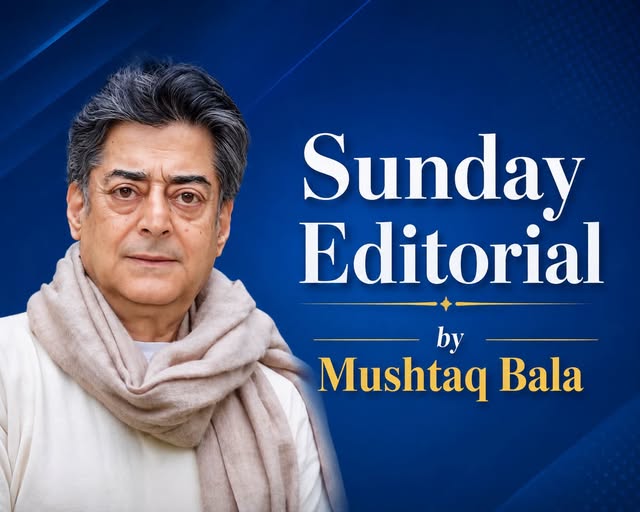
By Mushtaq Bala
As another week draws to a close, Jammu and Kashmir once again finds itself at the intersection of hope, political aspiration, development and uncertainty. The events of the past few days remind us that while governments formulate policies and political parties mobilise support, the true measure of progress lies in how these decisions improve the daily lives of ordinary people.
The dominant political narrative of the week has undoubtedly been the renewed demand for the restoration of Jammu and Kashmir’s statehood. From civil society resolutions at SKICC to large public gatherings at Hazratbal, and the announcement of a proposed protest at Jantar Mantar on July 20, the issue has once again occupied centre stage. Statehood today is not merely a political slogan; for many citizens it represents the restoration of democratic confidence, stronger institutional governance and greater public participation in decision-making. Whatever one’s political affiliation, it is evident that this question deserves sincere engagement through constitutional and democratic dialogue.
Alongside political developments, governance continued to move forward on several important fronts. The Chief Minister’s review of the power sector, emphasis on sustainable tourism, overseas employment for youth, expansion of medical education and fee waivers for economically weaker students reflect efforts to strengthen public services. Similarly, the administration’s push for solar energy, urban renewal projects, poverty mapping and transparent governance indicates that long-term planning remains essential for the Union Territory’s future.
Education also remained in focus. The introduction of institutional mechanisms to review academic material must be implemented with wisdom, transparency and academic independence. Protecting constitutional values and ensuring educational quality are legitimate objectives, but intellectual diversity and responsible scholarship should remain equally protected. A healthy democracy encourages informed debate rather than narrowing the space for ideas.
One encouraging aspect of the week was the continued success of the Shri Amarnath Ji Yatra. Lakhs of pilgrims are travelling peacefully through Kashmir, assisted by security forces, civil administration and local residents. Equally significant were the remarks of Mirwaiz Umar Farooq, who described the pilgrimage as a cherished tradition of Kashmir while urging that the convenience of local residents should also be safeguarded. Such balanced voices reinforce the Valley’s long-standing traditions of communal harmony and hospitality.
Nature, however, reminded us of its immense power. Heavy rainfall, flash floods, landslides and highway closures across several districts exposed the vulnerability of our infrastructure and communities. Climate change is no longer a distant concern—it is a present reality. Sustainable development, scientific urban planning, stronger disaster preparedness and environmental conservation must become central pillars of future policy. The directives to remove encroachments from wetlands and water bodies are therefore timely and deserve strict implementation.
The week also brought inspiring stories that deserve equal prominence. The achievements of Kashmiri women honoured through the Kashmir Women’s Organization Fellowship, the remarkable international success of Banihal-born entrepreneurs Johnny and Tony Beig at the FIFA World Cup, the accomplishments of motorcycle racer Saimah Ajaz Baig, and the artistic contributions of young performers, writers and theatre groups collectively demonstrate that Jammu and Kashmir possesses immense human talent waiting to flourish.
Economic development must continue to create opportunities for this talent. Tourism, entrepreneurship, sports, agriculture, renewable energy and industrial investment together can provide the employment that our youth urgently seek. Development must be inclusive, environmentally responsible and capable of reaching every district and every section of society.
The media also entered public discussion this week. Concerns regarding fake journalists and misinformation on digital platforms deserve careful attention. Credible journalism remains one of democracy’s strongest institutions. While accountability is necessary, it must never come at the cost of press freedom. Responsible journalism and responsible governance should strengthen—not weaken—each other.
Beyond our borders, tensions in the Middle East continue to deepen. Escalating confrontation involving Iran, the United States and regional powers has implications far beyond the battlefield. Global energy markets, international trade and economic stability remain closely linked to peace in the Gulf region. The world today needs diplomacy more than confrontation, dialogue more than military escalation.
Ultimately, the past week reflects the complex reality of Jammu and Kashmir—a land of political aspirations, administrative reforms, cultural richness, natural beauty and extraordinary resilience. The challenges are significant, but so are the opportunities.
As citizens, our greatest responsibility is to preserve peace, strengthen democratic institutions, protect our environment, encourage education and reject misinformation and division. Progress cannot be achieved through confrontation alone; it requires trust, accountability and collective participation.
At Kashmir Pen TV, we remain committed to presenting balanced, credible and people-centric journalism. Our responsibility is not merely to report events, but to encourage informed public discourse that contributes positively to society.
As we enter another week, let hope be guided by wisdom, development by sustainability, politics by constitutional values, and public life by mutual respect. Only then can Jammu and Kashmir move confidently towards the peaceful, prosperous and inclusive future its people truly deserve.
Have a thoughtful Sunday.
I’m Mushtaq Bala, Editor in chief, Kashmir pen TV, Thank you for reading.

