

SANJAY PANDITA
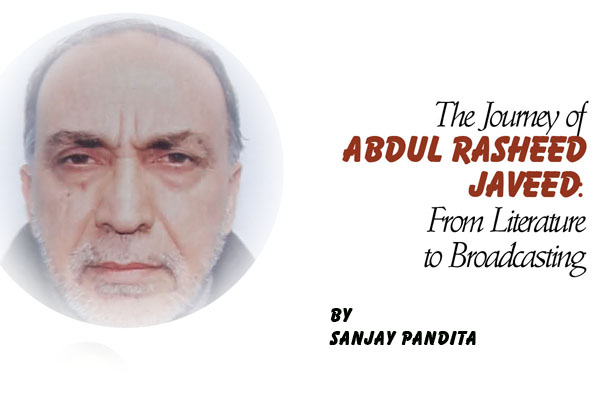
Abdul Rasheed, better known in cultural and literary circles as Rasheed Javeed, was born in 1952 at Badiyar, Basant Bagh, Lal Chowk, Srinagar. His life reflects a close connection with Kashmiri literature, theatre, and broadcasting. Coming from a locality where cultural activities and educational opportunities shaped many young minds, Rasheed grew up during a time when literature and performing arts were slowly finding new platforms in Kashmir.
Like many children of his generation, his education began at a local government school. He studied there until the 7th class, and from the 8th class onward, he joined M.P.H.S. School Srinagar, continuing there until his elective class. After finishing his school education, he pursued graduation, first in Islamia College and later in S.P. College Srinagar. Alongside his formal education, Rasheed developed an interest in languages and literature. He appeared privately in Kamil Kashmiri and also in M.A. Urdu, strengthening his base in Kashmiri and Urdu literary traditions.

During his college days, Rasheed tried his hand at writing. He recalls that his only ghazal was published in the S.P. College Magazine during the session 1972–73. Interestingly, the same issue also carried Rafeeq Raaz’s free verse poem “Wuhoo Vuhur,” which later became well known in Kashmiri literary circles. Rasheed also remembers the literary atmosphere of the time, when small groups and organizations were being formed by enthusiastic young writers. One such group, Talash-e-Adab, was founded by Rafeeq Raaz, Iqbal Fahim, and Shams-ud-Din Shameem. Another, Safeena-e-Adab, was started by Sheikh Tajamul-ul-Islam. Rasheed himself was associated with Safeena-e-Adab. The first group believed in Adab-Baraye-Adab (art for art’s sake), while the second advocated Adab-Baraye-Zindagi (art for life’s sake). These debates shaped the writing trends of that era.
Though Rasheed did not write much fiction, he did pen one short story titled Zolane. He presented this story before the respected Kashmiri poet and writer Amin Kamil, who suggested a more suitable ending for it. Later, the story was broadcast on the “Yuvavani” service of Radio Kashmir Srinagar. His first published piece in print was an article on Eid Meelad-un-Nabi (SAW), carried by the daily Aftab in 1973.
Another influence on Rasheed’s life came from his immediate surroundings. Opposite his house in Basant Bagh stood a building known as the “Theatre Building.” This complex housed several theatres, such as Vasant Theatre, Novrang Theatre, SangeRmaal Theatre, and Sangam Theatre. Rasheed joined Sangam Theatre in 1973, marking the beginning of his long association with stage plays.
As an actor, he participated in several plays staged at the Kashmir Theatre Federation festival, including Popyee Rood, Keij Rath, and Wutre Bunuyl. These plays were written by the noted dramatist Sajood Sailani, who was also the president of the federation. Rasheed received a certificate of merit for his performance in the Urdu play Chengez, staged at the drama festival of the J&K State Cultural Academy. He also acted in the Hindi feature film Mazhab. With time, he was elected Vice-President and Director of Sangam Theatre. As a director, he staged a Kashmiri adaptation of a Telugu play by Mohan Nirash under the title Mey Gatchi Nacheu.
In 1975, Rasheed took a more formal step into the cultural field by joining the J&K Cultural Academy as a Cultural Assistant. There he worked under senior officials such as Secretary M.Y. Taing, Deputy Secretary Ali Mohammad Lone, Cultural Officers Moti Lal Kemmu and Mehraj-ud-Din Shah. At that time, the Academy was a hub of literary and cultural activity and had many prominent figures associated with it. Personalities like Shashi Shekher Toshkhani, Rasheed Nazki, M.L. Saqi, Chaman Lal Chaman, Rasool Pompur, and M.A. Andrabi were actively engaged with the institution. Rasheed worked in this environment for six years before moving to broadcasting.

In 1981, he joined Doordarshan Srinagar as a Production Assistant. This shift opened up a new dimension in his career. His first assignments included assisting senior producers like Farooq Nazki and Ashok Jailkhani in the well-known television series Shab-Rang. In 1982, he was sent to the Film and Television Institute of India (FTII), Pune, for formal training in television production. On returning, he also assisted Javid Iqbal in the serial Insaaf.
Gradually, Rasheed began producing programmes independently. These included plays, serials, health awareness programmes, and literary features. His promotion to Programme Executive in 1999 gave him the responsibility of handling almost all the major productions of Doordarshan Srinagar. For nearly a decade, he focused on health and literary programmes, one of the most notable being Doctor Online, a live show where doctors interacted directly with viewers.

Apart from this, Rasheed worked on documentaries highlighting the lives and contributions of prominent literary and cultural personalities of Jammu and Kashmir. These included Prof. Rehman Rahi, Amin Kamil, G.N. Khayal, M.S. Bhagat, Margoob Banihali, Shams-ud-Din Ahmad, Zaman Aazurda, Gayoor Hassan, Maqsood Ahmad, Shaad Ramzan, and others. He also produced a documentary on Aga Ashraf Ali and one of his last such works featured Mohammad Abdullah Dev Nadeem.
Rasheed was also active as a playwright. His play Faschaal, included in his book Doh Losnas Taam, was both written and directed by him for television. He directed other productions as well, such as Pachiphur (written by Shakeel Azad), which holds the distinction of being the first serial shot in digital format at DDK Srinagar. He also produced Boond Boond Zindagi, Tsche Be Te Gulbadan, and Panin Te Parid.
His documentaries covered diverse subjects. For example, a four-part documentary on the S.P.S. Museum was scripted by Dr. Abdul Ahad. Another, Fight Against Cancer, written by Dr. Shad Saleem, highlighted the work of SKIMS, Srinagar, in combating cancer. A documentary with Dr. M.S. Khuroo focused on the discovery of Hepatitis B. Among these, one of the most significant works was Black Snow in Kashmir, which examined the environmental effects of the Iraq War on Kashmir. It was telecast nationwide on 27 July 1991 and even drew appreciation from the German Embassy in New Delhi for bringing attention to environmental concerns.
Rasheed’s work also extended to sports coverage. In 1985, he was deputed to Delhi to cover the National Games. He contributed to news and current affairs programming by initiating a short on-air segment featuring journalists from the valley to discuss ongoing issues. This was done during a period of political turmoil, making it a difficult task to carry out. Several newspapers, both in English and Urdu, later published their views on these productions.

Towards the end of his career, Rasheed produced two important programmes—one on Sheikh Mohammad Abdullah and the other on Sheikh-ul-Alam, Sheikh Noor-ud-Din Noorani (RA). These were his final projects before retirement.
Alongside his broadcasting career, Rasheed also pursued writing. He published two books. The first, Doh Losnas Taam, is a collection of three plays—two written by him and one by Riyaz Mahir. The second, Kahkashan, is an Urdu book of general information for children. His writings contributed to Kashmiri drama and also provided educational content for younger readers.
Even after retirement, Rasheed remained connected with cultural activities. On 21 August 2016, Doordarshan Srinagar invited him as a guest for its programme Good Morning J&K. He also took part in various features, interviews, and magazine programmes, including Film Magazine and discussions with literary figures.

Rasheed Javeed’s career shows a steady progression from a young writer and actor to a cultural worker and finally a television professional who contributed to literature, theatre, and broadcasting in Kashmir. His work covered theatre performances, radio broadcasts, cultural festivals, television serials, documentaries, health programmes, and children’s literature.
The writer can be reached at: sanjaypanditasp@gmail.com

