

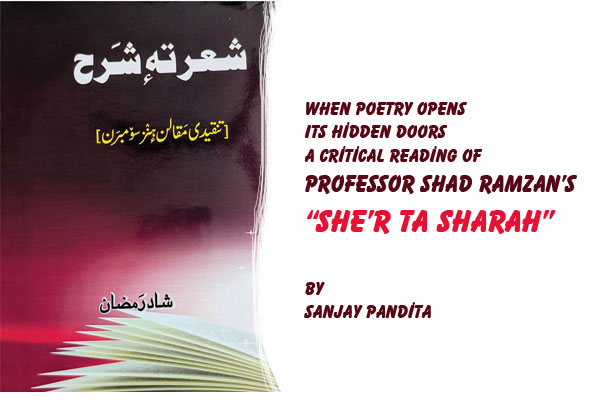
Poetry does not always reveal itself at the first reading. A poem may appear to say something on the surface while carrying within it another language—a language of memory, metaphor, silence and experience. To enter that inner world requires not only a sensitive reader but also a critic capable of recognising what lies beneath the apparent meaning of words. Professor Shad Ramzan’s She’r ta Sharah attempts precisely such an exploration, taking the reader into the fascinating territory where poetry meets interpretation.
Professor Shad Ramzan, a distinguished poet, scholar and critic of Kashmiri literature, brings together essays dealing with poetic creation, the creative possibilities of language, the evolution of literary forms and the richness of Kashmir’s poetic and Sufi inheritance. Read as a whole, the book becomes more than a collection of critical essays. It develops into a sustained conversation about how poetry is born, how language becomes art, how literary traditions travel and transform themselves, and how a poem continues to acquire new meanings through the memories and experiences of its readers.
The intellectual journey begins with Shae’ir, She’r ta Sharah—the poet, poetry and interpretation. The discussion reaches back to Plato and the ancient idea that poetic creation may involve an inspiration beyond the individual poet. This idea finds an interesting parallel in Eastern and Sufi traditions, particularly in the Kashmiri conception of gonmaath and the mystical experience of ilhaam. The poetry of Ghalib and Shams Faqir offers examples of poets who seem to experience inspiration as something arriving from beyond the conscious self.
Modern criticism, however, locates poetic creation within the extraordinary sensitivity of the poet and the conscious and subconscious reservoirs of experience. What appears to arrive suddenly may have been gathering silently within the mind for years. The poet remembers differently, feels more intensely and notices what remains invisible to others. Poetry may therefore emerge when something buried within the self reaches the surface and finds its form in words.
Yet the poem does not end with its creation. It begins another life when it reaches the reader. Interpretation becomes a second act of engagement, although no critic can claim to exhaust the meanings of a poem. Poetry has the capacity to exceed every explanation imposed upon it. The poem itself, its language and internal structure must remain the foundation of interpretation.
This leads naturally to the question of language in Zabaen Hyund Takhleeqi Vartaav. In everyday life, language primarily serves communication, but poetry refuses to remain within that utilitarian boundary. The poet takes an ordinary word and gives it another life. A familiar word may acquire an entirely different emotional or symbolic charge within a poem.
Metaphor, rhythm, image, suggestion and association allow poetry to make the familiar unfamiliar again. The poet does not necessarily invent a new language but discovers unexplored possibilities within the language everyone already speaks. Words live within contexts, memories and cultures, and poetic imagination can stretch their meanings beyond dictionary definitions. Literary language thus becomes a deliberate departure from ordinary expression in order to create aesthetic and emotional intensity.
From language, Shad Ramzan turns to literary form, particularly the ghazal. Ghazal: Sinfi Shinakhat ta Vartaav traces its journey from Persian into Urdu and Kashmiri and examines how Kashmiri poets gradually made the form their own. A literary form may arrive from elsewhere, but once it enters another cultural imagination, it begins to change. Mehmood Gami’s pioneering contribution and the later work of Rasul Mir, Mahjoor, Azad and others demonstrate how the Kashmiri ghazal developed its own sensibility. An inherited form became a vehicle for Kashmiri experiences, emotions and imagination. Tradition, therefore, survives not through repetition alone but through renewal.
One of the book’s strengths is its movement between literary theory and actual poetry. Shad Ramzan repeatedly returns to poets and poems rather than leaving the reader in abstract theoretical territory. His engagement with Professor Rehman Rahi, particularly Rahi’s poetic response to Ghalib, becomes an occasion to examine how one major poet enters into a creative dialogue with another and how literary influence can become creative transformation.
The essay on Rehman Dar’s Shashrang takes the reader into an especially fascinating territory. Associated with six colours or hues, Shashrang represents a meeting point of mystical experience, poetic imagination and oral cultural memory. Its colours invite a deeper reading because colour belongs to the visible world while mysticism seeks what lies beyond visibility. The paradox itself generates poetic richness.
In Sufi poetry, the external world often becomes a language of the inner world. A flower, colour, light, darkness, separation or beauty can become a sign of an inward journey. The visible becomes a metaphor for the invisible. The many colours of Shashrang can therefore be understood as different expressions of human experience, ultimately converging towards a larger spiritual awareness. Multiplicity does not necessarily destroy unity; it can reveal the many ways in which unity manifests itself.
Shad Ramzan’s concern with reading Kashmiri Sufi poetry through its own cultural and spiritual vocabulary is particularly significant. Kashmiri Sufi poetry emerged from a landscape shaped by mystical traditions, folk practices, nature consciousness and indigenous spiritual sensibilities. Its symbols carry cultural memories that cannot always be adequately approached through critical theories developed elsewhere. Shashrang therefore needs to be heard within the spiritual atmosphere from which it emerged.
The poem’s second life through the voice of the late Ghulam Ahmad Sofi, remembered as Ama Sufi, adds another dimension. Here the written poem crosses the boundary of the page and becomes song. The poet creates the words, but the singer gives them breath. In Kashmir, poetry has historically travelled through books as well as gatherings, devotional singing, folk performers and oral memory. A poem repeatedly heard and sung gradually becomes part of collective consciousness. It begins to belong not only to its author but also to the people who preserve it through memory.
The comparative study of Shaikh-ul-Alam and Kabir widens this vision. Though belonging to different traditions and cultural contexts, both poets address questions concerning human conduct, truth, spiritual seeking and the relationship between the individual and the Divine. Such comparisons are meaningful when they do not erase differences but allow those differences to reveal points of spiritual affinity.
The essay on Samad Mir and Ahad Zargar explores another dimension of Kashmiri Sufi poetry. Both represent powerful mystical voices, yet their poetic temperaments differ. Ahad Zargar remains closer to traditional expressions and inherited symbols, while Samad Mir appears as a more innovative force, willing to create new combinations of language and imagery. Their comparison illustrates the two impulses through which literary traditions remain alive: preservation and renewal. Without memory, innovation loses its roots; without innovation, tradition risks becoming repetitive.
The discussion of Kashmiri ghazal—Kaeshur Ghazal: Vartav ta Vahrav returns to this continuing evolution. From Mehmood Gami and Rasul Mir to Mahjoor, Azad and later poets, the ghazal demonstrates how an inherited form can become deeply rooted in a new linguistic and cultural environment. Its history is ultimately a history of adaptation: every generation enters the old structure carrying a new world within.
The essay on contemporary Kashmiri nazm extends this evolution into modernity. Mahjoor and Azad helped establish the foundations of modern Kashmiri nazm, while subsequent poets expanded its thematic and formal possibilities. Free verse allowed poetry to respond more directly to social transformation, historical trauma and changing psychological realities. Yet modernity did not necessarily sever the connection with tradition. Even when poetic forms changed, the cultural memory embedded in the Kashmiri language remained present.
In Sokhnan Ma’ne Boz—Listen to the Meaning of Poetry—Shad Ramzan returns to the experience of listening. His references to street singers such as Rajab On of Anantnag and to poetry heard in devotional and Sufi gatherings reveal another truth: poetry can be experienced emotionally even without formal literary analysis. Sometimes melody reaches where explanation cannot. A line may enter memory before the mind has consciously understood its meaning. The ear itself can become a form of interpretation.
The final essay, Teli Kona Ayokh Yeth Baazras Manz, gives the volume its poignant cultural resonance. The old folk refrain about arriving in the marketplace when the shoes were adorned with golden thread becomes a meditation on a Kashmir that increasingly survives through memory. The marketplace becomes more than a physical space; it becomes a metaphor for a civilisation looking back at itself. The Rajatarangini, folk songs, idioms, proverbs and literary traditions together form an enormous archive from which the past continues to speak.
Perhaps this is where the different essays of She’r ta Sharah finally converge. Poetry is language, but it is more than language; it is memory, but it is more than memory. It is an individual voice that can become the voice of a people. A word can carry centuries, a song can preserve a vanished world, a metaphor can contain a philosophy, and a poem can travel from private consciousness into collective memory.
This is the larger significance of Professor Shad Ramzan’s work. He does not approach Kashmiri poetry as a museum of finished forms but as a living tradition in which the old and the new, the mystical and the modern, the written and the oral, the individual and the collective continue to converse.
For Kashmiri literature, such criticism has particular importance. Creative writing alone cannot preserve a literary tradition indefinitely. Literature also needs critics who can interpret its inheritance, rediscover neglected works, question established assumptions and create bridges between generations of writers and readers. She’r ta Sharah makes a meaningful contribution to that continuing process.
The book’s lasting value therefore lies not merely in the answers it offers but in the questions it encourages us to ask. Where does a poem begin—in experience, memory, subconscious impulse, divine inspiration, or somewhere beyond all these explanations? How does an ordinary word become extraordinary? When does a borrowed form become native? How does a mystical poem survive across generations? And how does a civilisation continue to speak when much of its visible past has disappeared?
These questions give She’r ta Sharah its enduring relevance. A poem is never completely explained; it opens another door. Professor Shad Ramzan invites us to enter those doors not with the certainty that everything behind them can be explained, but with the sensitivity to recognise that every poem contains more than its words appear to say.
That, perhaps, is the true task of criticism: not to imprison poetry within an interpretation, but to set free the meanings waiting silently inside it.
ABOUT THE REVIEWER
Sanjay Pandita is a Poet, Columnist, Author & Critical Analyst

