

SANJAY PANDITA
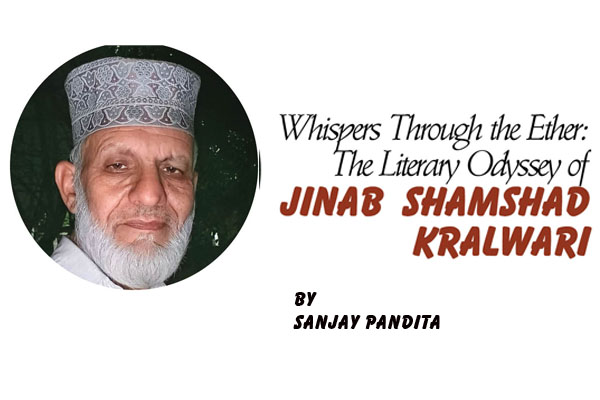
In a world ceaselessly humming with transient voices and vanishing echoes, it is rare to encounter a voice that not only lingers but deepens with time—becoming more luminous, more resonant, more necessary. Shamshad Kralwari is one such voice. His words—whether spoken through microphones or written with care—do not merely pass through the ether; they stay, settle, and sanctify the very air they traverse. Broadcaster, poet, translator, actor, cultural custodian—each role he has embraced is not a separate stream but a tributary feeding the vast river of his legacy. Born in the sylvan village of Kralwari in Chadoora, with the Doodh Ganga murmuring nearby like a lullaby from forgotten civilizations, Shamshad was destined not for noise, but for resonance.

The home into which he was born was modest, but its atmosphere shimmered with intellectual fire. Books were not decorations there—they were companions. Education was not merely a means to livelihood; it was the awakening of the soul. His father, a man of quiet wisdom, nurtured discipline not as compulsion but as reverence. In this radiant atmosphere, young Shamshad began to bloom—not with flamboyance, but with inner resolve. As early as the age of twelve, he began penning verses, his nascent couplets like the early rays of dawn breaking through a chinar forest:
Kortham yi dil devane janane katha kar
Nate Sarvi kheramane janane kath kar
These lines, tender and tentative, were not the ambitions of a child seeking fame—they were the early stirrings of a spirit bound to language.
He completed his matriculation in 1973 from Government High School Zuhama—a school founded by the visionary poet Abdul Ahad Azad, whose name is synonymous with Kashmir’s literary awakening. His academic journey led him to Amar Singh College and later to the University of Kashmir, where he earned master’s degrees in Persian and Kashmiri. Adding to his academic laurels, he pursued Honours in Urdu from Aligarh Muslim University, Lucknow. Yet, these degrees were mere confirmations of what was already evident: a mind both rigorous and receptive, deeply analytical yet disarmingly lyrical.
Shamshad’s engagement with culture went far beyond books. During his school years, he was a stalwart member of the cultural club and the renowned Maqbool Theatre Club from as early as 1970. His portrayal of Noshlab in Gulrez—a play staged more than twenty times—remains etched in the memory of all who witnessed it. He was not merely performing roles; he was learning to inhabit voices, to become a vessel for stories larger than himself. By Class 10, he was scripting and staging his own plays, laying the foundation for the multifaceted artist he would become.

The dream of becoming a broadcaster was not merely an adult ambition; it was a childhood prophecy. In school, he wrote an essay declaring his desire to speak on the radio. That essay was not an assignment—it was a compact with destiny. Destiny, it seems, listened. In the mid-1970s, Shamshad began volunteering as a broadcaster with Radio Kashmir and Yuvavani. Early programs like Mehjoor te Yavun and Aund Poek carried his voice into Kashmiri homes like a breeze that brought both warmth and wisdom.
He began his professional career as a schoolteacher, in line with societal expectations for educated youth. But the call of the airwaves proved irresistible. In 1988, he formally joined Radio Kashmir as a Program Executive. Over time, he would go on to head more than thirteen departments, especially during the upheavals following the 1990 exodus. In that turbulent period, broadcasting became not just an occupation, but a moral duty.
Perhaps his most sacred hour came during the unpredictable flood of 2014, when Kashmir was swallowed by water and silenced by disaster. Communication lines were cut. Networks collapsed. An eerie stillness blanketed the Valley. Yet, in this drowning silence, Radio Kashmir refused to go under. Under Shamshad Kralwari’s calm and commanding stewardship, it became a lifeline. Armed with just two microphones and a Nagra recorder, he initiated emergency transmissions atop Shankaracharya Hill. Broadcasting hope, direction, and human warmth amid watery ruin, the station stood its ground. For this unparalleled service, the Central Broadcasting Station of Radio Kashmir—helmed by him—was honoured as the Best Maintained Station in India for the year 2014, a quiet testimony to unwavering leadership during crisis.

Long before environmentalism became a buzzword and global forums began echoing eco-consciousness, Shamshad had already tuned in to nature. As early as 1991, he pioneered eco-broadcasts in Kashmir, weaving environmental themes into his programming with foresight and sincerity. It wasn’t tokenism—it was conviction. The Ministry of Environment took note, and under the stewardship of Saif-ud-Din Soz, formally honoured him for his contribution—a rare recognition for a broadcaster who not only spoke to his times but spoke ahead of them.
His programs—Baete Kath, Zuvan Pai, Hello Doctor, Rangha, Vadi Ki Awaaz—were not mere segments; they were soul-touching experiences. His innovations—such as live phone-in shows during curfews or rural development series rendered as human narratives—redefined what broadcasting could mean in a conflict-ridden landscape. His introduction of sponsored programming like Zona Dab merged commerce with conscience, without compromising dignity.
If the microphone was his sceptre, the pen has always been his soul.
His poem The Fog is not simply a composition—it is an atmosphere, a psychic condition. In its grey swirl, mist becomes metaphor—of forgetfulness, of ancestral exile, of veiled memory. He does not describe the fog; he breathes within it. Exile thickens in its folds; clarity blurs beneath its weight. Yet within that spectral obscurity emerges a maternal voice—tender, insistent, divine—calling the self back to the stars. The poem defies form, composed in free verse that meanders like mist itself. In The Fog, language becomes vapor, yet it carries the centuries within.
His critical work Kani Manz Naeran Gowhary stands as a luminous landmark in Kashmiri literary criticism. It is a profound exploration of Wali Mohammad Aseer’s contributions—not only to literature but to the historical consciousness of Kashmir.
In resurrecting Aseer’s intellectual legacy, Shamshad doesn’t merely critique—he commemorates. With Kani Manz Naeran Gowhary, he offers more than just a study; he crafts a tribute worthy of a literary titan who authored fifty-two books. Through this pioneering work—the first of its kind in Kashmiri—Shanshad brings not only analytical rigour but also emotional fidelity to his subject. The book doesn’t just examine Aseer’s contributions to literature and history; it reanimates them, establishing a new benchmark for how literary heritage can be preserved with both reverence and intellectual precision.

But perhaps his magnum opus is Jurm Ti Saza—his Kashmiri translation of Dostoevsky’s Crime and Punishment. Initiated in 1986 and completed nearly three decades later, this translation is an act of literary reincarnation. To let Raskolnikov breathe in the Kashmiri idiom, to have Russian despair echo through Sopore and Anantnag, was not just linguistic work—it was spiritual transference. Entirely self-funded, the project stands as a monument to artistic fidelity and devotion.
Following this, his rendering of The Brothers Karamazov (Brotheran Karmazo) expanded not just Kashmiri’s literary terrain but also its philosophical vocabulary. He treats the Kashmiri language not as a ceremonial relic, but as a living, thinking, evolving force. In his hands, it becomes not only the language of lullabies and laments, but of logic and light.
His oeuvre continues to glow with varied brilliance—from the evocative Gode Chhey Yivan Raath to the immersive Dhanes Ze Sair, and the illuminating Angliyat. His curatorial genius shines in Jami Marrifat, a mystical anthology showcasing the Sufi wisdom of poet Gulla Dhoon. His Urdu work Hajj Aur Darsi Hajj endures as both a spiritual and practical guide for pilgrims. Each line he writes, whether poetic or critical, carries his unmistakable signature—lucid, lyrical, luminous.

Among his most ambitious and sacred undertakings is his forthcoming word-by-word Kashmiri translation of the Holy Quran. Not merely a rendering of meaning, but an attempt to retain rhythmic fidelity, this project is both devotional and linguistic. It demands surrender more than scholarship, and faith as much as finesse. When complete, it promises to become a cornerstone in Kashmir’s religious and literary heritage—a bridge between divine revelation and the soft cadence of the Kashmiri tongue.
Equally anticipated is his upcoming work Cheshier, Kaeshir, Te Kaeshur , currently under publication. Through this, Shamshad is expected to dissect the cultural, linguistic, and philosophical essence of Kashmir—its body, its language, its soul. If his previous works are any indication, this too will serve as a mirror to a civilization that continues to whisper through mist, even as the world hurries past.
Recognition has followed—not with trumpet blasts, but with candlelight. He has been honoured with the ShashRang Award for promoting Sufi thought, accolades for agricultural and health awareness broadcasts, and commendations for drama and feature production. Sheikh Mohammad Abdullah once personally awarded him as the Best Debater. These honours, while significant, seem to merely brush the surface of a deeper cultural reverence that surrounds him.

Less publicized, but no less powerful, are his English essays and op-eds published in leading Kashmiri newspapers. Unadorned by jargon but enriched with introspection, these writings do not simply comment—they contemplate. His gaze is shaped by scripture and revolution, yet always anchored in compassion. In an era of performative punditry, Shamshad Kralwari’s prose is the hush that follows a wise man’s truth.
Today, Shamshad Kralwari is not merely a man—he is an ethos. His life is not a tale of climbing ladders, but of planting roots. He has never chased the spotlight, yet the light has found him. In the breath between two broadcasts, in the pause before a poem, in the hush of snowfall on abandoned temples—you can hear him. Still whispering. Still present.
The boy from Kralwari once dreamt of a microphone. Today, his voice lingers like fog upon the mountains—soft, persistent, unforgettable. So long as truth seeks a tone and memory seeks a medium, Shamshad Kralwari will whisper through the ether—not fading, but forever becoming.
The writer can be reached at sanjaypanditasp@gmail.com

