

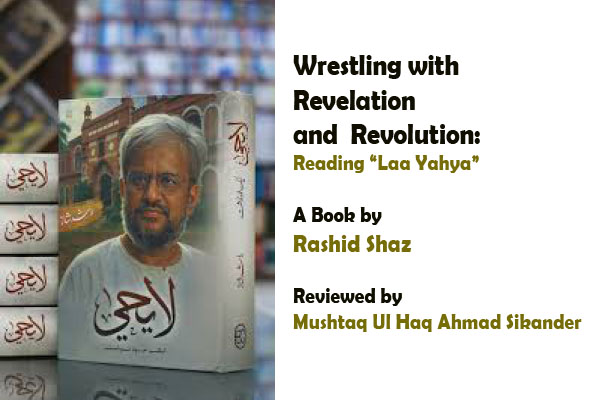
Laa Yahya: Ek Khudnawisht
Author: Rashid Shaz
Publisher: Peace India International, Jamia Nagar, New Delhi, India
Year of Publication: 2025
Pages: 552
Price: Rs 700
ISBN: 9788198832634
Introduction: The Autobiography as Metaphor
Rashid Shaz’s Laa Yahya: Ek Khudnawisht is an extraordinary work in the corpus of modern Indian Muslim autobiography. It is not merely the life story of a dissenting scholar; it is a moral cartography of a tormented conscience negotiating truth, politics, and faith in a world suspicious of all three. Written as a sequel to Laa Yamoot, the earlier volume of his spiritual self-exploration, Laa Yahya continues the story of an intellectual wrestling with revelation and revolution alike. It is simultaneously a chronicle of one man’s journey and a sociological diagnosis of an entire community’s descent into confusion, fear, and political impotence.
The very title — Laa Yahya — is ironically self-reflexive. It conveys the existential exhaustion and moral paralysis that define not only Shaz’s personal ordeal, but also, symbolically, the “death-in-life” condition of Indian Muslims in the post-Partition milieu. Across its 552 pages, Shaz fuses personal memoir with political commentary, theology with journalism, introspection with interrogation. The result is a text that resists easy classification: at once confessional, polemical, prophetic, and pedagogical. It demands to be read not for entertainment but for enlightenment — an exercise in self-critique intended to awaken a dormant collective consciousness.
The Continuity of Crisis: From Laa Yamoot to Laa Yahya
To fully appreciate Laa Yahya, one must read it as an extension of Laa Yamoot — the earlier volume where Shaz documented the awakening of his intellectual and spiritual sensibilities. If in Laa Yamoot he explored how divine truth revealed itself to him through moments of crisis, in Laa Yahya he records how that truth tested his endurance amidst worldly opposition. From the outset, he makes a provocative assertion: “Truth is never democratic — it needs no majority to validate itself.” This aphorism becomes the philosophical skeleton of the autobiography. Shaz’s constant struggle stems from his refusal to dilute this truth for comfort, popularity, or political expediency.
He begins the narrative with youthful reflections — his uncertainty about future prospects, his alienation from the regimented confines of salaried labour, and his desire to find meaning beyond the materialist rhythms of nine-to-five existence. His sojourn in Sudan, where he studied Arabic, forms a pivotal phase in his life. There, he was exposed not only to linguistic depth but also to the living ferment of Islamic reformist discourse. The vibrancy of the Arab intellectual milieu, juxtaposed against the dogmatic rigidity of the subcontinental Muslim institutions he had known, gave Shaz a vantage point for critique and creative mediation.
His exploration of underground Sufi movements in Mecca adds another layer to the narrative. It reveals the tension between orthodoxy and mysticism in his own intellectual formation. Shaz’s engagement with Sufism was not mystical escapism; it was a rebellion against the monopolization of spirituality by clerical hierarchies. In these moments, Laa Yahya resembles a philosophical diary, recording the making of a mind through encounters with living contradictions.
Between Imamate and Khilafat: The Crisis of Leadership
The book’s early chapters deal extensively with the question of Muslim leadership — theological as well as political. One episode describes how Shah Abdullah accepted Shaz’s advisory note with generosity, while Iranian President Mohammad Khatami dismissed it, claiming he could not be advised “as a Leader of Muslims.” (P-33) Shaz interprets this contrast through the prism of doctrinal division: the Shia belief in Imamate versus the Sunni notion of Khilafat. His point is not sectarian but analytical — to show that both systems, in modern practice, have ossified into forms of authority resistant to introspection.
Through this contrast, Shaz exposes the theological roots of Muslim political stagnation. Whether in the sectarian particularism of Imamate or the bureaucratic fossilization of Khilafat, both models have failed to produce moral legitimacy in the modern age. By narrating his experience of being sidelined by powerful leaders, Shaz dramatizes the dilemma of the contemporary Muslim intellectual — tolerated as ornament, rejected as conscience.
Hyderabad: The Erased Massacre
One of the most powerful and disturbing portions of the book concerns the massacre of Muslims in Hyderabad during the early years of Indian independence. Shaz meticulously revisits this suppressed chapter of history, arguing that the Sunderlal Committee report, which had documented the killings, was deliberately shelved — a political decision to protect the image of Congress secularism. He accuses the Congress Party, along with military establishments and Hindutva outfits, of orchestrating and facilitating the massacre.
This section exemplifies Shaz’s method of moral historiography. For him, historical silence is not absence of facts but a carefully maintained lie. The Hyderabad tragedy becomes symbolic of a structural pattern: the denial of Muslim suffering as the precondition for national legitimacy. Shaz writes of it not as detached historian but as ethical witness, indicting not only the perpetrators but also the complicit silence of intellectuals and religious leaders who traded truth for patronage.
The Tyranny of Fatwas
Few contemporary Muslim reformers have critiqued the institution of fatwa as rigorously as Rashid Shaz does in Laa Yahya. He treats the fatwa not as jurisprudential tool but as sociopolitical weapon. Far from being advisory opinions as they were originally conceived, modern fatwas, he argues, have become instruments of conformity, often coinciding with state propaganda or sectarian agendas.
Shaz recounts a series of examples: the fatwas legitimizing U.S. forces in Saudi Arabia during the Gulf War; the condemnations of Saddam Hussein; the denunciations of Syrian Alawites; and the sanctification of alliances that openly contradicted Quranic ethics. His diary entries from January 1991, written while in Saudi Arabia as the Gulf War raged, capture a rare immediacy. They show a man spiritually and politically disillusioned — witnessing Islamic clerics transform Shariah into a vocabulary of imperial service.
When he later describes the destruction of Baghdad in 2003 — the burning of its libraries and looting of its museums — the imagery evokes the Mongol catastrophe of 1258. But his purpose is not nostalgia; it is diagnosis. For Shaz, the repetition of Baghdad’s fall signifies cultural suicide — the Ummah’s inability to learn from history because it has substituted obedience for intellect.
The Genesis and Tragedy of Milli Parliament
If Laa Yahya has a central dramatic narrative, it is the rise and fall of the Milli Parliament (MP), Shaz’s most ambitious effort to institutionalize Muslim self-critique and autonomy in India. Conceived as a forum for self-introspection and national regeneration, the MP symbolized his vision of Islam as a living sociopolitical ethos, not merely a ritual identity.
Shaz gives a detailed account of its conception: a National Convention designed to wean Muslims away from dependency on “non-Muslim approval” and rebuild self-confidence broken by years of post-Partition marginalization. Yet from its inception, the project met resistance. The press ridiculed it as fanatic, secular-left intelligentsia dismissed it as regressive, and traditional ulema denounced it as presumptuous. The tragedy, Shaz notes, is not that his movement failed to attract non-Muslim allies, but that it was sabotaged by internal insecurities within the Muslim community itself.
The demolition of Babri Masjid in 1992 marks the turning point. Shaz recounts the helpless search for a joint ulema statement condemning the act — a mission that failed as every scholar invoked doctrinal nuance or political caution. In the aftermath of the demolition and ensuing Mumbai riots, Shaz observes an eerie analogy: Indian Muslims became “the Jews of Asia,” targeted, vilified, and economically destroyed. Their loss of faith in the political establishment created a vacuum that the MP temporarily filled, offering intellectual direction when emotion had replaced leadership.
Yet this very emergence provoked hostility. Established organizations like the AIMPLB, Jamaat-e-Islami Hind, and Milli Council perceived the MP as a threat to their dominance. Propaganda labelled it extremist, and even sympathetic scholars distanced themselves. Still, Shaz insists that the process, not the outcome, justified the effort. The MP, he writes, “broke the ice of historical inertia,” challenging Muslims to rethink themselves beyond the vocabulary of minority rights and constitutional appeasement.
Beyond the Binary: Secularism and Political Morality
In analysing Shaz’s reflections following the collapse of MP, one encounters some of the most penetrating political philosophy produced by an Indian Muslim thinker in decades. He refuses both communal self-pity and liberal secularism as frameworks for emancipation. His rhetorical question — “How can secularism be acceptable in India if it is unacceptable in other Muslim countries?” — may sound provocative, but it exposes the hypocrisy of selective modernity. For Shaz, secularism in India has become the religion of expediency — a mechanism that grants minorities survival but denies them dignity.
In this context, his decision to boycott the 13th Lok Sabha elections, along with his proposal to establish the Khilafat Party, must be understood as acts of intellectual integrity, not political extremism. The boycott was based on a moral argument: participation in an unjust system that systematically excludes genuine representation is complicity, not citizenship. His letter to the Election Commission demanding fair Muslim representation in Muslim-majority constituencies, though dismissed by critics, demonstrates his practical engagement with procedural justice — not a flight from democratic responsibility but an appeal for its ethical completion.
The Scholar Torn Between Action and Reflection
In the mid-sections of Laa Yahya, Shaz turns introspective, analysing the dual personalities within himself — the “revolutionary” and the “researcher.” The revolutionary sought change through activism, speeches, and organization; the researcher preferred solitude, scholarship, and long-term civilizational analysis. Their conflict reflects the eternal tension between praxis and contemplation. Shaz’s candour in portraying this struggle lends the autobiography psychological depth rare in political writing.
He admits that his activist side often alienated academics, while his scholarly caution frustrated activists. This confession resonates with the predicament of many Muslim intellectuals who oscillate between prophetic urgency and hermeneutic patience. In choosing to dissolve the MP in 2001 — on the grounds that unity was more sacred than institutional continuity — Shaz symbolically privileged moral cohesion over organizational ego. This gesture, as he narrates it, transforms failure into sacrifice, translating political defeat into ethical victory.
Post-9/11 and the Collapse of Dialogue
As Laa Yahya proceeds into the first decade of the new millennium, the narrative widens from Indian to global Islam. Shaz documents the early efforts among Muslim thinkers to generate a culture of peaceful dialogue, even among former militants who had renounced violence. However, he laments that George Bush’s so-called “War on Terror” extinguished these dialogues by criminalizing Muslim self-expression itself. The war, disguised in secular rationales of “Just War,” continued the logic of the medieval Crusades with modern vocabulary.
From Saudi Arabia, where he observed the cultural transformation of nomadic life into urban consumerism, to the Palestinian crisis and Iraq’s destruction, Shaz’s eyewitness reflections blend reportage with elegy. Particularly moving is his meditation on the Saudi skyline, where skyscrapers have replaced tents: “The concrete jungles,” he writes, “have swallowed the horizon of the desert and suffocated the poetry of sand.” In this poetic denunciation of material culture, one hears both nostalgia and foresight — the lament of a civilization losing its moral compass to petro-dollar ambitions.
The Indian Context Reinvented: Gujarat and Modi’s India
No Indian Muslim autobiography of recent years confronts the Gujarat riots (2002) with Shaz’s combination of anger and analysis. He contrasts the global outrage over Gujarat with the muted response to earlier massacres, attributing the new visibility to the age of the Internet — the birth of a digital conscience. Yet he insists that outrage without organization will not redeem the community.
He also notes a crucial difference between Congress and BJP-era violence. Whereas previous pogroms were euphemized and ceremonially condemned by “secular imams” who legitimized Congress’s duplicity, Modi’s Gujarat had no ulema-mask to hide behind. Shaz regards this exposure as paradoxically liberating, forcing Indian Muslims to confront their true position in the Republic. For him, the choice is neither fatalism nor futile protest, but realism — a self-aware, morally grounded participation in public life without illusion of protection from pseudo-secularism.
Shia-Sunni Divides and the Spiritual Bankruptcy of Authority
Shaz’s analysis of post-2003 sectarian crises in the Muslim world is one of the most intellectually sophisticated portions of Laa Yahya. He sees in the Shia-Sunni schism not mere theological difference but a civilizational pathology: the absolutization of interpretive authority. Whether acceptance of dead imams or devotion to Sufi saints, the underlying problem is the same — the institutionalization of faith that replaces reflection with obedience.
From Mehdi Army to ISIS, from Najaf to Raqqa, he sees one continuous pattern — movements using religion as pretext for power, reducing divine message to dead slogans. His critique, however, is not cynical. It is corrective. He calls for a re-engagement with the Quranic model of moral individuation, where interpretation is not monopolized but shared as communal responsibility. In this light, Laa Yahya reads as a manifesto for de-clericalization, a call for returning Islam to its scriptural simplicity and moral grandeur.
The Trials of a Modern Heretic
The later chapters of the book narrate Shaz’s confrontation with orthodox institutions after his appointment as Director of the Bridge Course at Aligarh Muslim University. What could have been an occasion for reform turned instead into a modern inquisition. His ideas were misrepresented; he was accused of undermining traditional faith; even a fatwa from Deoband declared him a kafir. Wild rumors claimed he had spent “thirteen years in Israel” — a slander symbolizing the paranoia of religious establishments against intellectual independence.
What Laa Yahya reveals here is not simply Shaz’s personal persecution but the systemic fear of reform that pervades Muslim institutions. He notes bitterly that instead of confronting moral decay, scholars prefer scapegoats. In one of the book’s most moving passages, he writes: “When I was teaching how bridges could be built between faith and reason, they mistook it for an attempt to bridge madrasas with hell.” Such irony encapsulates the intellectual tragedy of our time.
Reform and Rebirth: From Idraak-e-Zawal to Future Islam
Shaz situates his earlier works — Idraak-e-Zawal-e-Ummat and Future Islam — as intellectual extensions of his autobiographical journey. In Laa Yahya, he explains their genesis against the backdrop of censorship and condemnation. He also contextualizes them within the lineage of persecuted Muslim thinkers like Nasr Abu Zayd and Mahmoud Mohammad Taha, whose reformist readings of Islam led to exile or execution.
His invocation of these figures is more than solidarity; it is declaration of lineage. Shaz identifies himself with the minority of believers who refuse to trade reason for ritual. He repeatedly insists that intellectual freedom is an act of faith, not rebellion — that to think anew is to honour revelation, not deny it. This connection between faith and freedom forms the ethical climax of Laa Yahya. He calls for a “paradigm shift” in Muslim thought: from the fiqhi obsession with legality to the Quranic imperative of moral universality.
The Autobiography as Collective Mirror
At its deepest level, Laa Yahya transcends autobiography to become collective autobiography — the story of Indian Muslims told through the conscience of one man. Every episode — from the Hyderabad massacre to Babri demolition, from the Milli Parliament to Gujarat — stands as a parable of a community oscillating between fear and faith, between survival and self-respect. Shaz’s vantage point as a participant in many of these events gives the narrative documentary credibility, while his moral intensity transforms it into civilizational critique.
The reader encounters a writer who has witnessed too much to pretend, felt too deeply to remain neutral. Yet his tone remains remarkably free of bitterness. When he dissects the failures of Muslim leadership — religious or secular — his purpose is not revenge but restoration. He invites the Ummah to reimagine faith not as fortress but as frontier.
Style and Structure: The Lyric of Defiance
In terms of literary style, Laa Yahya is both dense and lyrical. Its prose oscillates between the analytical and the elegiac. Shaz combines the documentation of a historian, the passion of a preacher, and the cadence of a poet. His language often carries prophetic resonance, reminiscent of Abul Kalam Azad’s Ghubar-e-Khatir in moral tone though darker in spirit. Certain passages shimmer with allegorical imagery — mosques described as “abandoned mirrors reflecting broken prayers,” or Baghdad’s smoking ruins likened to “a library that remembered too much.”
This poetic expressiveness does not dilute his argument; rather, it amplifies it. The structure of the book is not linear; it follows the rhythm of recollection, moving between past and present, personal and political. This nonlinearity mirrors the fluidity of memory and resembles postcolonial testimonial writing more than traditional autobiography. It is less a chronological record than a mosaic of moral experiences.
Shaz in the Larger Intellectual Tradition
Rashid Shaz occupies a unique and often uncomfortable position in South Asian Muslim thought. Unlike the traditionalist ulema, he is not rooted in seminarian authority; unlike liberal modernists, he does not romanticize Western categories of secularism and progress. His thought navigates the liminal space between orthodoxy and enlightenment — seeking an Islam that is internally self-corrective yet resistant to ideological colonization.
In this regard, Laa Yahya can be fruitfully compared with the works of Ali Shariati, Ismail Raji al-Faruqi, and in the Indian context, Maulana Azad. Yet Shaz differs in temperament: he writes not from the optimism of early independence but from the fatigue of its betrayal. His narrative is the record of a postcolonial believer inhabiting a world where both faith and freedom are fragmented.
Evaluation and Significance
In academic terms, Laa Yahya: Ek Khudnawisht stands as one of the most intellectually ambitious Muslim autobiographies written in contemporary India. It is autobiographical testimony, historical commentary, and theological intervention rolled into one. Its academic value lies in its multidimensional insight:
As a historical document, it reconstructs key sociopolitical events from an insider’s perspective.
As a theological critique, it challenges the abuse of fatwa, the paralysis of ulema, and the moral bankruptcy of political Islam.
As a literary work, it extends the tradition of moral prose that blurs the line between confession and resistance.
The book also performs a vital corrective function in South Asian studies, offering a counter-narrative to both liberal-secular and Islamist historiographies. It rescues the Indian Muslim subject from the dichotomy of victimhood and terrorism by presenting him as moral agent, capable of self-critique and hope.
Conclusion: Between Life and Resurrection
Laa Yahya ends not with resolution but reflection. Shaz accepts the loneliness of truth-seeking as divine necessity. His story, at one level, is of an individual misunderstood by his peers; on another, it is the lament of a civilization that replaced prophets with politicians, jurists with clerks, and ideas with slogans. Yet embedded within the despair is a quiet faith in resurrection — the belief that moral clarity, once uttered, cannot be unspoken.
For readers and scholars alike, Laa Yahya demands engagement at multiple levels — moral, historical, philosophical, and literary. It is a book to be argued with, not merely admired; a text one returns to when easy optimism collapses and faith seeks intellectual renewal. In giving voice to his ordeals, Rashid Shaz has in fact written the collective autobiography of our age — an age that lives yet does not live, breathes yet does not awaken.
ABOUT THE REVIEWER
M.H.A.Sikander is Writer-Activist based in Srinagar, Kashmir.
First published in Newageislam

