

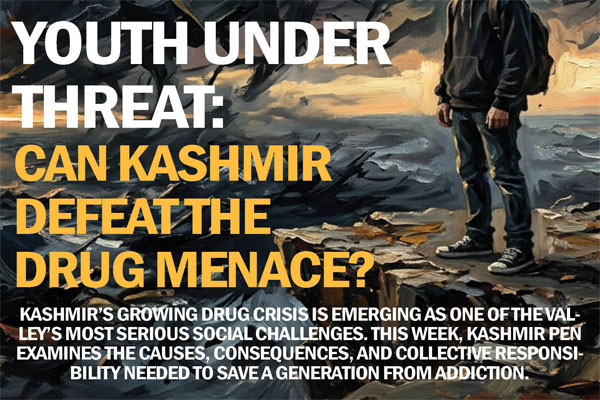
Kashmir’s growing drug crisis is emerging as one of the Valley’s most serious social challenges. This week, Kashmir Pen examines the causes, consequences, and collective responsibility needed to save a generation from addiction.
Once known for its spiritual ethos, cultural richness, and close-knit social fabric, Kashmir today faces a silent but dangerous crisis — the alarming rise in drug addiction among its youth. What was once considered an isolated problem has now evolved into a serious social and public health challenge affecting families, educational institutions, and communities across the Valley. Behind closed doors, countless parents are struggling to save their children from the grip of narcotics, while society searches for answers amid growing concern and uncertainty.
The Disturbing Rise
Over the past few years, authorities, healthcare professionals, and social activists have repeatedly expressed concern over the increasing availability and consumption of drugs in Jammu and Kashmir. From urban centres to remote villages, substance abuse is no longer confined to any particular class or locality.
Medical experts warn that addiction among teenagers and young adults has witnessed a worrying rise, with substances ranging from cannabis and prescription drugs to heroin and synthetic narcotics becoming increasingly accessible. Rehabilitation centres in Kashmir have also reported growing admissions, particularly among young patients.
A Crisis Beyond Statistics
The drug menace is not merely a law-and-order issue; it is a human tragedy unfolding silently within households. Parents often discover the problem too late — after academic decline, behavioural changes, depression, or financial distress begin affecting family life.
Teachers speak of students losing focus and motivation. Counsellors describe emotional isolation, anxiety, and peer pressure driving vulnerable youth towards substance abuse. In many cases, social stigma prevents families from seeking timely help.
Experts believe unemployment, psychological stress, social alienation, and the influence of negative online content have further aggravated the situation.
Society Must Respond Together
While law enforcement agencies continue their crackdown against narcotics networks, experts stress that policing alone cannot solve the crisis. The fight against drugs requires collective social responsibility.
Religious scholars, teachers, parents, media organizations, artists, and civil society groups all have a role to play in awareness and prevention. Educational institutions must introduce stronger counselling systems and awareness programmes aimed at protecting students from addiction.
Recent anti-drug campaigns and rallies organized across Kashmir have shown encouraging public participation, particularly among the youth. Such initiatives reflect a growing realization that silence is no longer an option.
The Role of Rehabilitation
Mental health professionals emphasize that addiction should be treated primarily as a health issue requiring compassion, rehabilitation, and long-term support. Recovery is possible when timely intervention, counselling, medical treatment, and family support work together.
Several rehabilitation centres and NGOs in Kashmir are making sincere efforts to help recovering addicts reintegrate into society. However, experts believe much more infrastructure and trained manpower are needed to address the scale of the challenge.
Media and Cultural Responsibility
Media institutions, filmmakers, writers, and artists also carry an important responsibility in shaping public consciousness. Sensitively highlighting the dangers of addiction while promoting hope, awareness, and positive role models can influence young minds constructively.
Kashmir has historically drawn strength from its spiritual traditions, literary culture, and collective values. Reviving these cultural and moral foundations may prove essential in protecting future generations from despair and self-destruction.
Conclusion
Kashmir today stands at a critical crossroads. The drug crisis threatens not only individual lives but also the social and moral fabric of society. The need of the hour is awareness, compassion, vigilance, and collective action.
Saving Kashmir’s youth is not the responsibility of one institution alone — it is a mission that belongs to every home, every school, every community, and every citizen.
The battle against drugs can still be won, but only if society acts before another generation is lost in silence.

