

By Shereen Naman
Kashmir’s heritage is not only etched in its mountains and rivers but written delicately in ink on fragile paper—handwritten Qurans, centuries-old manuscripts, and rare texts that testify to a civilisation steeped in faith, scholarship, and art. For decades, many of these treasures lay forgotten, vulnerable to decay and conflict. Today, a new wave of revival is breathing life back into them, ensuring that Kashmir’s literary and artistic memory is not lost to time.
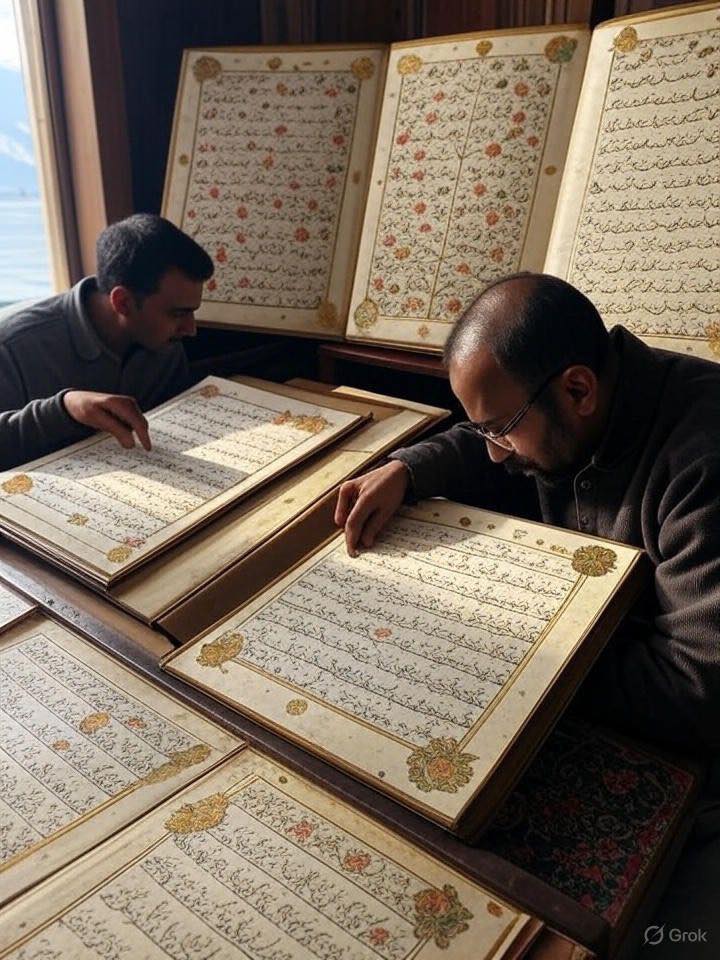
For centuries, Kashmir has been a cradle of calligraphy and manuscript tradition. In graceful Naskh script and other classical styles, Kashmiri artisans copied religious and literary works with devotion. Handwritten Qurans, illuminated with delicate floral patterns and natural dyes, became heirlooms passed down generations. Yet time, neglect, and conflict left many of these manuscripts vulnerable to decay.
A significant push In this revival came with the establishment of the National Mission for Manuscripts centre in Srinagar, set up in collaboration with the Indian National Trust for Art and Cultural Heritage (INTACH). This centre has been systematically identifying, cataloguing, and restoring manuscripts across the Valley. Specialists trained in conservation science are at work here, using techniques like Japanese tissue repair, organic adhesives, and controlled deacidification to prolong the life of fragile folios.
The centre also plays a vital role in outreach—encouraging families and custodians of manuscripts to bring forward their collections. Once hidden in wooden chests and ancestral homes, Qurans and other rare texts are now being documented, digitised, and preserved under professional care. Many of these manuscripts, including illuminated Qurans dating back to the 14th and 15th centuries, reveal how Kashmiri calligraphers blended devotion with artistry, adorning their work with gold borders, lapis lazuli inks, and intricate floral motifs unique to the Valley.
Private custodians are also contributing to the effort. Families who once hesitated to part with their manuscripts are increasingly collaborating with the centre, allowing their collections to be digitised for posterity. Alongside Qurans, the archive includes Sufi treatises, Persian poetry, and traditional medical texts, all of which are being catalogued and made accessible to researchers worldwide.
Cultural observers say this revival is more than preservation; it is an assertion of Kashmir’s identity. At a time when modernity often sidelines tradition, the painstaking revival of manuscripts is a reminder of the Valley’s deep intellectual and artistic roots. It is also a way of reconnecting with a collective memory that conflict and neglect nearly erased.
The challenges remain daunting. Thousands of manuscripts are still at risk from moisture, fire, and neglect. Conservation is painstaking, expensive, and slow. Yet the Srinagar Manuscript Centre, with INTACH’s support, has created a momentum that scholars believe will expand in the coming years.
As I want to put it: “Every time I save a manuscript, I save a piece of Kashmir’s soul.”
In many ways, the revival of manuscripts in Kashmir is not only about conserving paper and ink—it is about protecting a people’s imagination and intellectual inheritance. These fragile folios, once buried in dust, now remind the world that Kashmir has always been more than a place of beauty; it is a place of ideas. To save these manuscripts is to ensure that Kashmir’s voice—its art, its faith, its wisdom—continues to speak across centuries.

